

Growing from 10 to 50 employees creates a hiring problem: demand for new talent rises fast, but a full-time head of talent at $120K to $180K rarely makes sense when volume is still unpredictable. A fractional recruiting model gives early-stage teams access to experienced hiring without an internal recruiter, keeping cost per hire aligned with actual growth needs.
TLDR:
-
You can scale from 10 to 50 employees without a head of talent by using fractional recruiters, who set their own hourly rates and generally cost a fraction of the $18,000 to $36,000 an agency charges for the same hire.
-
Build a repeatable hiring process with templates, clear ownership, and weekly pipeline reviews to cut hours from each hire.
-
Speed matters: strong candidates often move through the market in two to three weeks, while longer, six-week processes frequently lose them to faster competitors.
-
Some modern solutions offer a free ATS plus access to vetted fractional recruiters who work hourly with no contracts, saving startups $100,000+ in recruiting costs.
-
Agency fees scale with salary, while fractional recruiting costs scale with actual hiring effort.
Why Startups Avoid Hiring a Full-Time Recruiter until 50+ Employees
Many startups wait until they reach roughly 50 employees before bringing on a full-time recruiter. The math is straightforward: a head of talent typically costs $120,000 to $180,000 annually in salary alone, plus benefits, equity, and onboarding time. For a company making 10 to 15 hires per year, that’s a steep per-hire cost.
Industry benchmarks often cite an average cost per hire of roughly $4,000 to $5,000 in the United States, though actual costs vary widely by role, seniority, and hiring method. When you’re hiring sporadically, paying a full-time salary for recruiting work that ebbs and flows doesn’t make financial sense. You end up either underutilizing an expensive hire during slow periods or overwhelming them during growth spurts.
Early-stage startups need every dollar focused on product development and customer acquisition. A dedicated recruiter is a functional investment that comes after you’ve proven product-market fit and secured predictable revenue.
The tipping point usually arrives around 50 employees when hiring becomes consistent enough to support a full-time role. Until then, founders piece together solutions: they recruit themselves, tap their networks, work with agencies sporadically, or bring in fractional recruiting support as needed. Knowing the signs your startup needs a recruiter can help you decide when to make that call.
What Actually Breaks: 4 Failure Modes of the Single-Recruiter Model
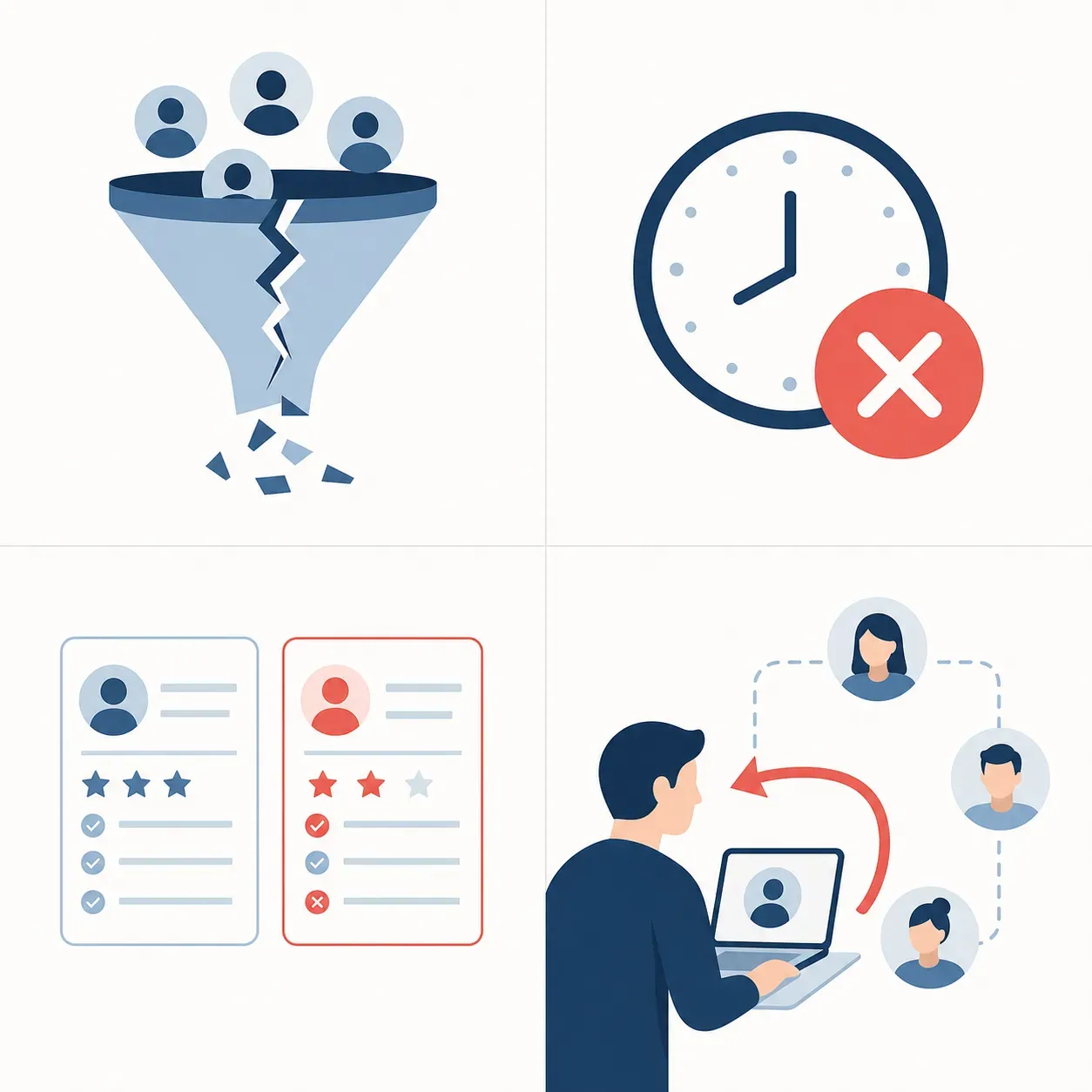
Stretching one recruiter across 8 to 12 open roles hits a hard ceiling fast, and the effects show up quietly until they become costly.
Pipeline Throughput Collapses
A single recruiter can maintain 3 to 4 active sourcing campaigns at once. Roles beyond that stall, with engineering requisitions suffering most because technical screening doesn’t compress well.
Candidate Experience Degrades
Response times slip from 24 to 48 hours to 5 to 7 days when one person manages inbound across a dozen pipelines. Strong candidates accept other offers in that window.
Interview Process Loses Consistency
Scorecards go stale, calibration sessions get skipped, and hiring managers fall back on subjective criteria. Debrief decisions slow down and candidates go cold.
Founders Re-Enter the Recruiting Loop
Overflow from a maxed-out recruiter lands on the founder: sourcing hard-to-fill roles, unblocking stalled pipelines, and negotiating offers all pull leadership away from product and revenue work.
The Real Costs of Scaling from 10 to 50 Employees
Scaling from 10 to 50 employees means more than adding 40 salaries to your burn rate. The real expense comes from what you pay to find, vet, and close those hires.
Traditional recruiting agencies charge 15% to 30% of first-year salary per placement. For a $120,000 engineering hire, that’s $18,000 to $36,000 in fees alone, and empty seats during a long search delay product work and compound missed revenue.
Building Your First Hiring Process without a Recruiting Team
Map every step of your hiring flow: sourcing channels, screening questions, interview participants, and decision criteria. Then build templates for outreach, scheduling, and rejections, plus a three-to-five-point scorecard every interviewer uses. For seed-stage teams still figuring out role sequencing, a recruiting roadmap for seed startups can help prioritize which roles to fill first.
Assign clear ownership for each stage and run weekly pipeline reviews to catch stalls early. The goal is a repeatable system any team member can run without founder involvement.
Fractional Recruiters vs. Traditional Agencies: A Cost Comparison
The fractional recruiting model has grown rapidly. LinkedIn and other labor market reports have shown rapid growth in fractional recruiter and contract-based roles over the past few years, particularly among startups and small teams.
Traditional agencies charge 15% to 25% of first-year salary per hire. For five $100,000 hires, that’s $100,000 to $125,000 in placement fees. Fractional recruiters work hourly, and each one sets their own rate. Across Dover’s marketplace, hires have averaged about $4,000 per hire on average, with a median of about $2,700. Treat that as arithmetic on typical rates and hours, not a quote: the actual figure depends on the recruiter you pick and how hard the search turns out to be.
| Traditional Agency | Fractional Recruiter | |
|---|---|---|
| Fee structure | 15% to 25% of first-year salary per hire | Hourly, at a rate the recruiter sets (typically $75 to $125) |
| Cost per hire (example: $100K role) | $15,000 to $25,000 | Roughly $2,250 to $6,000 |
| 5 hires at $100K salary | $100,000 to $125,000 | ~$11,250 to $30,000 |
| 10 hires | ~$200,000 | $22,500 to $60,000 |
| Contracts required | Yes, per-placement agreement | No long-term contract; hourly, retainer, or pay-per-hire |
| Best fit | One-off executive searches | Consistent multi-role hiring |
A 35-person Series A team running 6 engineering searches through an agency faces $108,000 to $216,000 in placement fees; the same six roles worked hourly by a fractional recruiter at typical rates would be a small fraction of that, though the exact figure depends on the recruiter’s rate and the hours each search takes. Beyond cost, the fractional path can compress time-to-fill from roughly three months to 5 to 6 weeks because a dedicated recruiter focuses exclusively on that team’s pipeline.
Agencies make sense for one-off executive searches where specialized networks support the premium. Fractional recruiters work better for consistent hiring across multiple roles where you need dedicated support without the markup. A detailed breakdown of agency recruiting vs. recruiter marketplace options can clarify which model fits your stage.
Sourcing Strategies That Work without a Recruiting Budget
Employee referrals are among the highest-converting hiring channels. Offer a $1,000 referral bonus, which costs a fraction of agency fees, and ask your team to share open roles in their networks.
Use LinkedIn’s free search filters to reach five targeted prospects daily. Post on free boards like AngelList and Y Combinator’s Work at a Startup, and ask investors to amplify across their networks.
Time to Hire Benchmarks and Why Speed Matters
Multiple hiring benchmarks put average time to hire in the 40-45 day range in recent years. For startups scaling from 10 to 50 people, that pace kills momentum. An empty engineering seat delays your product roadmap by weeks. An open sales role means prospects go to competitors first.
Many strong candidates field multiple offers at once, and a six-week process frequently loses them to competitors running tighter two-week timelines. The structural lever is not more interview rounds; it is eliminating dead time between the stages you already run.
Speed up your hiring by testing what matters most in the first interview. Need technical chops? Run coding assessments in round one, not round three. Schedule interview loops in single-day blocks when you can. Make offer decisions within 24 hours of the final conversation.
The point isn’t rushing into bad hires. It’s cutting dead time between steps and making clear decisions with the information you already have.
Designing Interview Processes That Scale
Build a consistent three- to four-stage structure with clear objectives at each step: baseline qualifications first, core skills in round two, then team fit. When every interviewer knows their focus, you cut confusion and speed up decisions.
Question Banks and Calibration
Develop role-specific question banks so all interviewers ask the same questions. Run quick 15-minute calibration sessions before interviews start to align on what “strong communication” or “technical proficiency” means for your team.
Keep Lean
Cap interview panels at four people maximum, each owning one evaluation area, and schedule debriefs within 24 hours of final interviews.
Tools for Hiring without an Internal Recruiter (Why Dover Is the Obvious Choice)
If you’re hiring without an internal recruiter, your stack has to do more than track applicants. It needs to handle sourcing, scheduling, and execution without turning into a mess of disconnected tools.
Dover gives early-stage teams a free, unlimited ATS with job distribution, referrals, pipeline tracking, and a careers page, with no setup friction or per-seat fees; AI applicant scoring and AI note taking sit on a $199/month Premium plan. When hiring ramps up, Dover’s recruiter marketplace lets you bring in an experienced startup recruiter to handle sourcing, screening, and closing, then scale down when demand slows, with no long-term contract and no percentage-of-salary agency fee. Because both your team and the recruiter work from the same pipeline, there’s no handoff friction and no data loss when the engagement ends.
Dover is also the infrastructure layer that fractional recruiting agencies are built on. Agencies that run fractional recruiting operations use Dover’s ATS and pipeline tooling as the shared system connecting their recruiters and clients. For teams that prefer working with a fractional recruiting agency over a solo recruiter, Dover’s marketplace includes vetted recruiters with published reviews from past clients, so you can see real performance data before committing to any engagement.
FAQs
What is the best free applicant tracking system for a team just starting to hire?
Dover offers a free, unlimited ATS covering job distribution, pipeline tracking, referral management, and interview feedback forms with no per-seat fees, plus a $199/month Premium plan for AI applicant scoring and AI note taking. Other free-tier options include Zoho Recruit (one active job, one user), SmartRecruiters (basic pipeline management), and Breezy HR’s Bootstrap plan (one active position), all of which hit limits quickly as hiring volume grows. The right free ATS handles the full pipeline without forcing an upgrade the moment you post a second role.
Should I hire a fractional recruiter or a fractional CHRO for a 20-40 person startup?
For teams under 30 focused on headcount growth, a fractional recruiter clears the immediate bottleneck, but between 30 and 50 employees, when HR compliance gaps start surfacing, layering in fractional CHRO support starts to make sense.
What hiring tools do most YC-backed startups use?
Ashby is common at Series A, combining ATS, scheduling, and analytics in one tool, while Greenhouse appears at Series B and beyond where teams need integrations across a larger HR stack. Pre-seed and seed-stage teams typically run lighter, pairing a free or low-cost ATS with LinkedIn and either a fractional recruiter or founder-led hiring for the first 10 to 15 roles. Dover fits this phase well, pairing a free ATS with on-demand fractional recruiting support and Y Combinator’s Work at a Startup board as a sourcing channel.
Do I need a recruiter if I’m already using an ATS?
An ATS organizes your pipeline by tracking applications, automating scheduling, and keeping candidates from falling through the cracks, but it cannot source passive candidates, run outbound campaigns, or close offers on your behalf. For senior, specialized, or hard-to-fill roles, a fractional recruiter working inside that same ATS fills the gap without requiring a separate tool or a long agency contract.
Final Thoughts on Growing from 10 to 50 Employees without Dedicated Recruiting
Growing from 10 to 50 employees without a full-time recruiter is realistic when hiring is treated as a system, not a scramble. Fractional recruiting support keeps roles moving without pulling founders away from product or revenue work. Whether you work directly with a fractional recruiter or go through a fractional recruiting agency, Dover fits this stage well: a free ATS paired with on-demand recruiter access, built as the shared system both teams and agencies operate from when focused on hiring without an internal recruiter.