How to Use an ATS to Hire Your First 10 Employees as a Startup in April 2026

Dover

April 27, 2026

3 mins

When you hire your first 10 employees, every decision sets the foundation for everything that comes after. Each role carries weight, and a mis-hire at this stage can cost you months of momentum along with a considerable amount of money. An applicant tracking system gives early-stage teams a way to manage that process without losing candidates in spreadsheets or missing follow-ups because someone forgot to reply. This guide breaks down how to use an ATS to run a structured hiring process from your first role through your tenth.

TLDR:

  • An ATS keeps early hiring organized when founders juggle recruiting alongside product and sales work.

  • Structured scorecards and pipelines reduce mis-hires that can cost up to 30% of first-year salary, according to widely cited hiring estimates.

  • A fractional recruiting partner can handle sourcing and coordination at startup scale, so founders stay focused on the business.

  • Getting your first 10 hires right sets repeatable hiring patterns for the next 50 employees.

  • Free ATS tools and startup-friendly pricing mean you can run a structured process without burning through runway on expensive software.

When you hire your first 10 employees, every decision sets the foundation for everything that comes after. Each role carries weight, and a mis-hire at this stage can cost you months of momentum along with a considerable amount of money. An applicant tracking system gives early-stage teams a way to manage that process without losing candidates in spreadsheets or missing follow-ups because someone forgot to reply. This guide breaks down how to use an ATS to run a structured hiring process from your first role through your tenth.

TLDR:

  • An ATS keeps early hiring organized when founders juggle recruiting alongside product and sales work.

  • Structured scorecards and pipelines reduce mis-hires that can cost up to 30% of first-year salary, according to widely cited hiring estimates.

  • A fractional recruiting partner can handle sourcing and coordination at startup scale, so founders stay focused on the business.

  • Getting your first 10 hires right sets repeatable hiring patterns for the next 50 employees.

  • Free ATS tools and startup-friendly pricing mean you can run a structured process without burning through runway on expensive software.

Why Startups Use an ATS to Hire Their First 10 Employees

Why Startups Use an ATS to Hire Their First 10 Employees

For most startups, the appeal comes down to a few practical realities:

  • Founders are usually doing recruiting alongside everything else, so having one place to track applicants, schedule interviews, and collect feedback from teammates keeps the process from falling apart between meetings.

  • Early hiring decisions often involve multiple stakeholders with different opinions, and an ATS creates a shared record so everyone is working from the same information instead of competing versions of a conversation.

  • When you're moving fast, consistency matters. An ATS helps you apply the same process to every candidate, which reduces the risk of overlooking someone good or advancing someone for the wrong reasons.

What to Look for in an ATS before You Hire Your First 10 Employees

What to Look for in an ATS before You Hire Your First 10 Employees

Not every ATS is built with early-stage startups in mind, and choosing the wrong one can slow you down at exactly the wrong time. An ATS can provide measurable benefits for small teams, but only when the features match your current stage. Before you commit to a tool, there are a few things worth checking.

Features That Actually Matter at the Early Stage

Look for these before signing up for anything:

  • Job posting distribution that can push your roles to multiple job boards automatically, so you're not manually reposting the same listing everywhere.

  • A candidate pipeline view that lets you see where every applicant stands at a glance, without digging through email threads.

  • Interview scheduling that syncs with your calendar and reduces the back-and-forth with candidates.

  • Collaboration tools that let a co-founder or hiring manager leave notes and feedback without needing a separate thread.

  • Reporting on basics like time-to-fill and source quality, so you can see what's working early.

Pricing That Fits a Startup Budget

Many ATS tools charge per seat or per job posting, which adds up fast. Look for free tiers or startup-friendly pricing that won't punish you for hiring in bursts. Some tools offer flat monthly pricing regardless of how many roles you open, which tends to be more predictable when headcount is growing unevenly.

ATS

Free Tier

Best For

Pricing Model

Key Strength

Dover

Yes

Seed to Series A startups

Free ATS with optional recruiting services

Built-in fractional recruiting support

Ashby

No

Scaling startups (20+ employees)

Per-seat, annual contracts

Advanced reporting and analytics

Greenhouse

No

Mid-stage startups and up

Per-seat, tiered plans

Structured interviewing frameworks

Lever

No

Teams blending ATS and CRM

Per-seat, annual contracts

Combined ATS and candidate CRM

Workable

Limited

SMBs hiring across departments

Per-job or flat monthly

200+ job board integrations

Breezy HR

Yes

Small teams with simple workflows

Free tier, paid plans per company

Visual drag-and-drop pipeline

How to Hire Your First 10 Employees Using Your ATS

How to Hire Your First 10 Employees Using Your ATS

Each stage of early hiring maps to a specific ATS workflow. Here is how to work through it:

Requisition and Job Posting

Start by creating a job requisition inside your ATS. Define the role, hiring manager, and approval chain before the job goes live. Many ATS tools let you publish directly to multiple job boards from one interface, which saves meaningful time when you are posting across LinkedIn, Indeed, and niche boards simultaneously.

Building Your Pipeline

Set up a custom pipeline for each role with stages like Applied, Phone Screen, Technical Interview, Offer, and Hired. As candidates move through stages, your ATS tracks candidate touchpoints so fewer details fall through.

Structured Scorecards

Attach a scorecard to each stage so every interviewer rates candidates against the same criteria. This keeps early hiring decisions grounded in data instead of gut feeling.

Offer and Onboarding Handoff

Once a candidate clears the final interview, generate the offer directly inside the ATS and connect it to your HRIS for onboarding if integrations are available. Keeping this handoff inside one system reduces errors and gets new hires productive faster.

How Hiring Your First 10 Employees Fits Into Your Full Hiring Pipeline

Your first 10 hires do more than fill seats. They set patterns for your next 50 hires. If those patterns form inside an ATS, they're repeatable and improvable. If they form in inboxes and spreadsheets, you inherit the chaos.

A connected pipeline looks like this: candidates enter through job boards, referrals, or outreach, move through a structured process with scorecards attached, and hand off to onboarding with full context already in the system. When parts of that happen outside an ATS, issues can arise quickly.



Here's what typically goes wrong without one:

  • Candidate data from early hires disappears, making it impossible to re-engage strong candidates when a similar role opens later.

  • Evaluation turns inconsistent when interviewers aren't scoring against the same criteria across every candidate.

  • Without hiring analytics, you can't tell which sources or pipeline stages are actually working.

Early hires often come through personal networks, too. Tracking those referrals from day one gives you visibility into your most reliable hiring channel before you scale.

When to Bring in a Fractional Recruiter to Support Hiring Your First 10 Employees

Hiring your first 10 employees pulls founders in every direction at once. You're closing deals, managing product, and trying to run a hiring process that actually works. At some point, the recruiting work starts to crowd out everything else, and that's often when bringing in outside help makes sense.

A fractional recruiter works part-time on your open roles without the cost of a full-time hire. They write job descriptions, source candidates, coordinate interviews, and keep the process moving while you stay focused on the business.

Signs It's Time to Get Help

  • You have multiple open roles at once and no clear system for tracking candidates or moving them through stages.

  • Your time-to-fill is stretching past 60 days because sourcing keeps getting deprioritized.

  • You're making offers without a consistent interview process, which creates legal risk and inconsistent hires.

Dover offers fractional recruiting built for early-stage startups, pairing founders with experienced recruiters who have deep startup hiring backgrounds and can plug into your ATS from day one.

The Cost of Getting Hiring Your First 10 Employees Wrong as a Startup

A bad early hire costs more than most founders expect. Some hiring estimates suggest a bad hire can cost up to 30% of that employee's first-year earnings. For a $120,000 role, that's $36,000 gone before you've seen any return.

But the financial hit is only part of it. Bad hires slow down teams, create management headaches, and push good people out the door. At the seed or Series A stage, that kind of friction can stall momentum at exactly the wrong time.

Why Early Hiring Mistakes Are Hard to Reverse

When your team is small, every person carries disproportionate weight. A weak engineer, an unfocused sales rep, or a disorganized ops hire affects everyone around them.

  • Misaligned hires often require weeks of management time to course-correct before a founder accepts the fit is wrong.

  • Replacing someone mid-stage means re-opening a search while the remaining team absorbs extra work.

  • Culture patterns set early tend to compound, making a few poor hiring decisions harder to undo as the company grows.

Getting your first 10 hires right is worth the investment in a structured process.

How Dover Helps Startups Hire Your First 10 Employees Without the Overhead
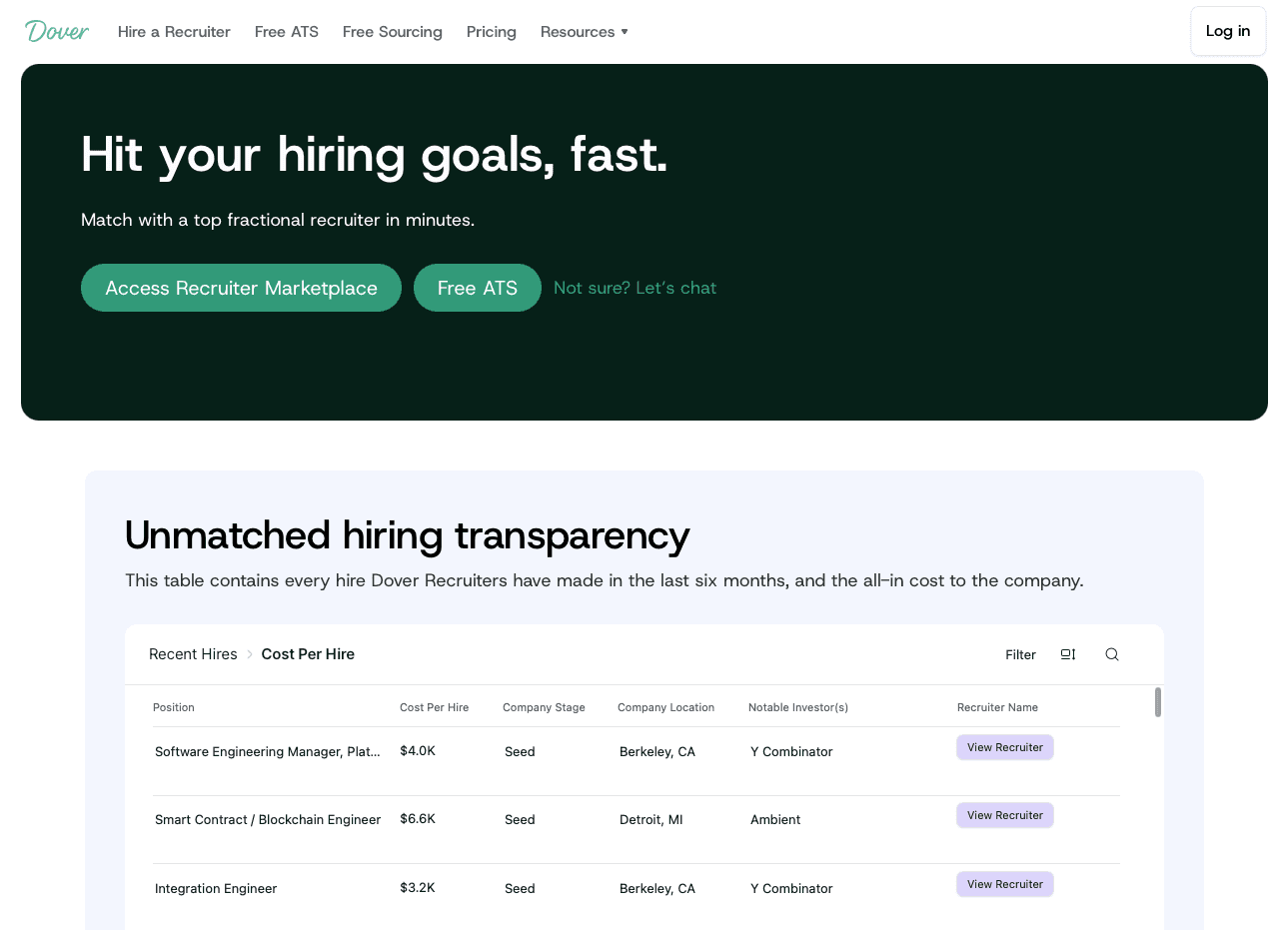
Dover is built for early-stage startups that need to hire well without standing up a full recruiting function. Instead of forcing founders to choose between expensive agencies and doing everything themselves, Dover acts as an on-demand recruiting partner that handles the work behind sourcing, outreach, and coordination.

Dover pairs your company with experienced recruiters who have deep startup hiring backgrounds. Instead of handing you a generic job description template and wishing you luck, Dover's team works alongside you to build a sourcing strategy, write compelling outreach, and manage candidate pipelines from the first role to the tenth.

A few things that set Dover apart for early-stage teams:

  • Recruiters focus on startup hiring contexts, so they understand the difference between hiring employee number three and employee number thirty.

  • Sourcing and outreach are handled for you, so founders can stay focused on the business instead of spending hours in LinkedIn Recruiter.

  • The model is designed to scale down as well as up, which means you only pay for what you actually need at a given stage.

  • Candidate coordination and scheduling are managed end-to-end, reducing the back-and-forth that typically eats up founder time.

For startups figuring out how to use an ATS to hire your first 10 employees, Dover also integrates with your ATS so that every candidate touchpoint is tracked, documented, and visible to your whole team.

Dover is built for early-stage startups that need to hire well without standing up a full recruiting function. Instead of forcing founders to choose between expensive agencies and doing everything themselves, Dover acts as an on-demand recruiting partner that handles the work behind sourcing, outreach, and coordination.

Dover pairs your company with experienced recruiters who have deep startup hiring backgrounds. Instead of handing you a generic job description template and wishing you luck, Dover's team works alongside you to build a sourcing strategy, write compelling outreach, and manage candidate pipelines from the first role to the tenth.

A few things that set Dover apart for early-stage teams:

  • Recruiters focus on startup hiring contexts, so they understand the difference between hiring employee number three and employee number thirty.

  • Sourcing and outreach are handled for you, so founders can stay focused on the business instead of spending hours in LinkedIn Recruiter.

  • The model is designed to scale down as well as up, which means you only pay for what you actually need at a given stage.

  • Candidate coordination and scheduling are managed end-to-end, reducing the back-and-forth that typically eats up founder time.

For startups figuring out how to use an ATS to hire your first 10 employees, Dover also integrates with your ATS so that every candidate touchpoint is tracked, documented, and visible to your whole team.

Frequently Asked Questions

Can I build a structured hiring process without bringing on a full-time recruiter?

Yes. An ATS gives you the tools to run a repeatable hiring process without needing a dedicated recruiter on staff. Most early-stage teams use an ATS to manage pipelines, scorecards, and interview coordination while founders or hiring managers own the final decisions.

What's the difference between using an ATS and hiring a fractional recruiter?

An ATS is software that helps you track and organize candidates, while a fractional recruiter actively sources people, writes outreach, and manages candidate relationships on your behalf. Many startups use both: the ATS keeps everything organized while the recruiter does the hands-on work of filling roles.

What features actually matter in an ATS before you hit 10 employees?

Look for job board distribution, a clear candidate pipeline view, interview scheduling that syncs with your calendar, and collaboration tools that let your team leave feedback without separate threads. Early on, simplicity beats feature depth: you need something that works immediately instead of requiring weeks of configuration.

Can I build a structured hiring process without bringing on a full-time recruiter?

Yes. An ATS gives you the tools to run a repeatable hiring process without needing a dedicated recruiter on staff. Most early-stage teams use an ATS to manage pipelines, scorecards, and interview coordination while founders or hiring managers own the final decisions.

What's the difference between using an ATS and hiring a fractional recruiter?

An ATS is software that helps you track and organize candidates, while a fractional recruiter actively sources people, writes outreach, and manages candidate relationships on your behalf. Many startups use both: the ATS keeps everything organized while the recruiter does the hands-on work of filling roles.

What features actually matter in an ATS before you hit 10 employees?

Look for job board distribution, a clear candidate pipeline view, interview scheduling that syncs with your calendar, and collaboration tools that let your team leave feedback without separate threads. Early on, simplicity beats feature depth: you need something that works immediately instead of requiring weeks of configuration.

Final Thoughts on Using an ATS to Hire Your First 10 Employees

The way you hire your first 10 employees shapes every hiring decision that follows, and the right tools make that process repeatable instead of chaotic. Dover gives early-stage startups a way to run structured hiring from day one, pairing founders with experienced fractional recruiters and a free ATS that handles job distribution, candidate tracking, and team collaboration without the overhead of enterprise software or agency fees. If you're building your founding team and want a recruiting partner that scales with you, start a conversation with Dover to see how it fits your hiring plan.

The way you hire your first 10 employees shapes every hiring decision that follows, and the right tools make that process repeatable instead of chaotic. Dover gives early-stage startups a way to run structured hiring from day one, pairing founders with experienced fractional recruiters and a free ATS that handles job distribution, candidate tracking, and team collaboration without the overhead of enterprise software or agency fees. If you're building your founding team and want a recruiting partner that scales with you, start a conversation with Dover to see how it fits your hiring plan.