
Full Life Cycle Recruiting: Everything You Need to Know (April 2026)

Dover
•
5 mins

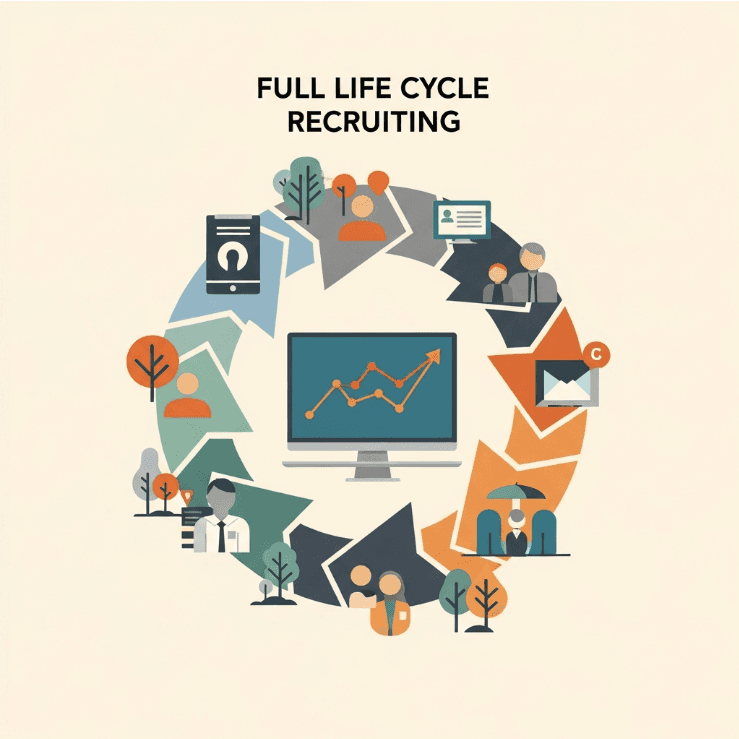
Full life cycle recruiting is an end-to-end approach to hiring where one recruiter owns the entire process from start to finish. From writing the job requisition to extending the offer and getting someone through onboarding, a single person holds accountability at every stage.
In many large organizations, recruiting is split across specialists. A sourcer finds candidates, a coordinator schedules interviews, a hiring manager handles offers. Each handoff introduces friction, miscommunication, and gaps in candidate experience. Full cycle recruiting collapses that chain into a single point of ownership.
That ownership distinction matters more than it might seem. When one recruiter knows the role deeply, has built the candidate relationship, and understands what the hiring manager actually wants, better decisions get made faster. Nothing gets lost between departments.
You'll see this model called by a few names: full life cycle recruiting, full cycle recruiting, or end-to-end recruiting. They all describe the same thing.
Each stage builds on the last, and rushing through any one of them tends to create problems downstream. These recruiting process steps provide a framework that full cycle recruiters adapt based on role requirements and company needs.
1. Preparing
Before any outreach happens, the recruiter works with the hiring manager to define the role, write the job description, set compensation bands, and align on what a strong candidate actually looks like.
2. Sourcing
Active outreach through job boards, LinkedIn, referrals, and direct sourcing. The goal is building a qualified pipeline, not collecting resumes.
3. Screening
Resume review and phone screens filter for minimum qualifications and basic fit before the broader team gets involved.
4. Selecting
Structured interviews, assessments, and reference checks. The recruiter coordinates feedback and guides the hiring team toward a decision.
5. Hiring
Extending the offer, negotiating compensation, and securing a signed offer letter. This is where candidates most often go cold, so staying close matters.
6. Onboarding
Getting the new hire set up for success. Some full cycle recruiters hand off at the offer stage; others stay involved through day one and beyond. Either way, onboarding closes the loop.
The core difference comes down to ownership. In a specialized model, recruiting is divided: sourcers, coordinators, hiring managers, and closers each handle a slice. In full cycle recruiting, one person carries the whole thing.
Neither approach is inherently better. The right choice depends on hiring volume, team size, and how much coordination overhead you can absorb.
Factor | Full Life Cycle Recruiting | Specialized/Traditional Recruiting |
|---|---|---|
Accountability | Single recruiter owns outcome | Shared across multiple roles |
Candidate experience | Consistent point of contact | More handoffs, higher drop-off risk |
Best fit | Startups, small teams, targeted hiring | High-volume enterprise hiring |
Coordination cost | Low | High |
Ramp-up time | Faster per role | Slower across the chain |
Specialized recruiting makes sense at scale. When a company is filling hundreds of roles simultaneously, dividing the work by function can increase throughput. Sourcers get very good at sourcing. Coordinators keep pipelines moving. The tradeoff is a fragmented candidate experience and accountability gaps at every handoff.
Full cycle recruiting trades volume capacity for depth. One recruiter who owns the role has far more context than three specialists passing notes between stages. That context leads to better screening, stronger candidate relationships, and fewer late-stage surprises.
"The candidate doesn't care how your org chart is structured. They care whether someone knows the role, communicates consistently, and treats the process like it matters."
For most startups and growing companies hiring selectively, full cycle recruiting is the more practical choice.
Full Life Cycle Recruiter Job Description and Responsibilities
Full life cycle recruiters touch every part of hiring, which makes the role harder to scope than most. The core responsibilities tend to stay consistent across companies, even when the job title varies.
Those responsibilities typically include:
Partnering with hiring managers to define roles and set expectations before sourcing begins
Writing and posting job descriptions across relevant channels
Sourcing candidates through outreach, referrals, and job boards
Running phone screens and coordinating interview panels
Collecting and synthesizing feedback from interviewers
Managing offers, negotiations, and closing
Tracking pipeline metrics and reporting on hiring progress
The skill set required spans both soft and hard capabilities. Strong sourcers who can't build candidate relationships hit a ceiling. Strong communicators who can't assess technical fit make bad calls. The best full cycle recruiters combine sharp judgment with process discipline.
When writing a job description for this role, the most telling signal is whether a candidate can speak to specific outcomes at each stage, instead of only responsibilities. Anyone can list "sourced candidates." Fewer can explain their screen-to-interview conversion rate or how they've handled a collapsing offer.
Full Life Cycle Recruiter Salary and Compensation
Salaries vary considerably depending on geography, experience, and industry. The average full cycle recruiter in the U.S. earns around $128,315 per year, though that number moves quickly based on where you are and who you're hiring for.
California and Texas tend to sit at opposite ends of the range. Recruiters in San Francisco or Los Angeles often command $140,000 to $160,000 or more, while Texas-based roles typically land closer to $90,000 to $120,000. At companies like Amazon, senior or specialized recruiters can reach considerably higher through base plus equity.
For hiring managers, these numbers matter when setting expectations. A full cycle recruiter costs real money, whether in-house or fractional.
Benefits and Challenges of Full Life Cycle Recruiting
Full life cycle recruiting works well until it doesn't. The model has real advantages, but it also has a ceiling.

There are a few benefits worth knowing about:
One recruiter means one relationship for candidates, fewer dropped messages, and less confusion throughout the process
Accountability is clear, and if a hire goes wrong, you know exactly where the breakdown happened
Context stays intact across every stage instead of getting filtered through handoffs between different people
The challenges are just as real. Full cycle recruiting demands a rare combination of skills, and not every recruiter has equal depth across all six stages. Sourcing and closing require very different instincts, and at higher hiring volumes, one person hits capacity fast.
Full Life Cycle Recruiting for Different Company Sizes
How Long Does Full Life Cycle Recruiting Take?
How Dover Supports Full Life Cycle Recruiting for Startups
Frequently Asked Questions
Final Thoughts on the Full Recruiting Life Cycle
Table of contents
Kickstart recruiting with Dover's Recruiting Partners
