Which Recruitment Sources Should You Use in Your Hiring Process? (February 2026)

Dover

February 9, 2026

5 mins

When you need to fill a role, the real challenge is finding candidates and choosing the sources of recruitment that bring qualified people without wasting weeks of time. Job boards generate volume but bury you in noise, referrals help when they happen but are hard to plan around, and agencies deliver results at a steep price. Most teams struggle because they rely too heavily on one channel instead of building a system that pulls from several at once. The companies that hire well use a central hiring system to connect multiple recruitment sources, balance speed with quality, and stay in control of both time and cost.

TLDR:

  • Combine internal and external recruitment sources to access diverse talent pools.

  • Employee referrals generate 38% of hires while job boards create 90% of applicants.

  • 70% of qualified candidates are passive, requiring direct outreach beyond job postings.

  • Fractional recruiters cost ~$2,000-$7,000 per hire vs. $30,000+ for traditional agencies.

  • Certain solutions offer a free ATS with job board posting, AI screening, and access to vetted fractional recruiters.

When you need to fill a role, the real challenge is finding candidates and choosing the sources of recruitment that bring qualified people without wasting weeks of time. Job boards generate volume but bury you in noise, referrals help when they happen but are hard to plan around, and agencies deliver results at a steep price. Most teams struggle because they rely too heavily on one channel instead of building a system that pulls from several at once. The companies that hire well use a central hiring system to connect multiple recruitment sources, balance speed with quality, and stay in control of both time and cost.

TLDR:

  • Combine internal and external recruitment sources to access diverse talent pools.

  • Employee referrals generate 38% of hires while job boards create 90% of applicants.

  • 70% of qualified candidates are passive, requiring direct outreach beyond job postings.

  • Fractional recruiters cost ~$2,000-$7,000 per hire vs. $30,000+ for traditional agencies.

  • Certain solutions offer a free ATS with job board posting, AI screening, and access to vetted fractional recruiters.

What Are Sources of Recruitment?

What Are Sources of Recruitment?

Sources of recruitment are the channels you use to find and attract candidates for open roles. Think of them as your talent pipelines. Each source connects you to a different pool of potential hires, from internal promotions to job boards to employee referrals.



The right recruitment source mix varies by company, role, and hiring goals. Understanding what type of recruiter is best for your situation can help you make informed decisions. A startup filling its first engineering hire will need different channels than a growing company recruiting for sales roles.

Internal Recruitment Sources

Internal Recruitment Sources

Internal recruitment means looking at your current team first when a role opens up. This includes promoting employees, transferring people between departments, or posting jobs internally before going to external candidates.

The biggest wins are speed and cost. You skip lengthy sourcing and vetting processes because you already know these people. Internal hires also onboard faster since they know your company already.

The tradeoff: you're fishing in a small pond.

External Recruitment Sources

External Recruitment Sources

External recruitment taps into talent outside your organization through job postings, recruitment agencies, campus hiring, social media, and direct outreach to passive candidates.

You get access to skills your team doesn't have yet, along with fresh ideas and different experiences. This matters when hiring for specialized roles or scaling quickly.

The downside is time and cost. 70% of the global workforce is passive talent, meaning most qualified candidates aren't actively job hunting. You'll need to do outreach, on top of posting and waiting.

Employee Referral Programs

Employee referral programs turn your team into recruiters by encouraging them to recommend people from their networks. When someone on your team vouches for a candidate, that recommendation carries weight. They understand both the role and what it takes to succeed at your company.

82% of employers use employee referrals as a primary candidate source. Referrals also tend to stick around longer and ramp up faster than candidates from other sources.

To make referrals work, keep the process simple. Make it easy for your team to submit names and track candidates transparently.

Job Boards and Online Platforms

Job boards cast the widest net. Posting on Indeed, LinkedIn, or niche sites like Wellfound (formerly AngelList) gets your role in front of thousands of job seekers. The setup takes minutes, and candidates come to you.



The tradeoff: while job boards generate 90% of applicants, they only produce 38% of actual hires. You'll get volume, but sorting through unqualified applications eats time. Treat job boards as background noise, not your main strategy, and pair them with active sourcing and referrals.

Social Media Recruiting

Social media recruiting meets candidates where they already spend time. 94% of recruiters use LinkedIn, Facebook, and X (formerly Twitter) to source talent.

LinkedIn works best for direct outreach to passive candidates through search filters for role, company, or skills. Twitter and industry forums help build your employer brand and connect with niche communities.

Sharing team updates and company wins keeps you top of mind when someone's ready to switch jobs.

Recruitment Agencies and Staffing Firms

Recruitment agencies handle sourcing, screening, and sometimes interviewing for you. Traditional agencies charge 20-30% of a hire's first-year salary, which can mean $30,000+ per placement. Choosing the right recruiter for your startup can help you avoid these costs.

That pricing model works for hard-to-fill executive searches, but gets expensive when filling multiple roles. Fractional recruiting offers a different approach: experienced recruiters working hourly. Most companies spend $2,000-$7,000 per hire through fractional models.

Recruitment Source

Cost Per Hire

Time to Fill

Best Use Case

Employee Referrals

$1,000-$3,000 (referral bonus)

2-3 weeks

All roles where culture fit matters; produces 38% of actual hires

Job Boards (Indeed, LinkedIn)

$200-$1,000 (posting fees)

3-6 weeks

High-volume hiring; generates 90% of applicants but only 38% of hires

Social Media Recruiting

$0-$500 (organic outreach)

2-4 weeks

Passive candidates and employer branding; used by 94% of recruiters

Dover Fractional Recruiters

$2,000-$7,000 per hire

3-4 weeks

Specialized roles needing dedicated sourcing without long-term contracts

Traditional Recruitment Agencies

$30,000+ (20-30% of first-year salary)

4-6 weeks

Executive searches and hard-to-fill senior positions

Campus Recruitment

$3,000-$10,000 (event costs + travel)

3-6 months (seasonal cycles)

Entry-level and junior roles with long-term development potential

Direct Sourcing/Outbound

$500-$2,000 (tools + time)

4-8 weeks

Specialized or senior roles; targets the 70% of the workforce that is passive talent

You get dedicated recruiting help without long-term contracts or massive upfront fees.

Recruitment agencies handle sourcing, screening, and sometimes interviewing for you. Traditional agencies charge 20-30% of a hire's first-year salary, which can mean $30,000+ per placement. Choosing the right recruiter for your startup can help you avoid these costs.

That pricing model works for hard-to-fill executive searches, but gets expensive when filling multiple roles. Fractional recruiting offers a different approach: experienced recruiters working hourly. Most companies spend $2,000-$7,000 per hire through fractional models.

Recruitment Source

Cost Per Hire

Time to Fill

Best Use Case

Employee Referrals

$1,000-$3,000 (referral bonus)

2-3 weeks

All roles where culture fit matters; produces 38% of actual hires

Job Boards (Indeed, LinkedIn)

$200-$1,000 (posting fees)

3-6 weeks

High-volume hiring; generates 90% of applicants but only 38% of hires

Social Media Recruiting

$0-$500 (organic outreach)

2-4 weeks

Passive candidates and employer branding; used by 94% of recruiters

Dover Fractional Recruiters

$2,000-$7,000 per hire

3-4 weeks

Specialized roles needing dedicated sourcing without long-term contracts

Traditional Recruitment Agencies

$30,000+ (20-30% of first-year salary)

4-6 weeks

Executive searches and hard-to-fill senior positions

Campus Recruitment

$3,000-$10,000 (event costs + travel)

3-6 months (seasonal cycles)

Entry-level and junior roles with long-term development potential

Direct Sourcing/Outbound

$500-$2,000 (tools + time)

4-8 weeks

Specialized or senior roles; targets the 70% of the workforce that is passive talent

You get dedicated recruiting help without long-term contracts or massive upfront fees.

Recruitment agencies handle sourcing, screening, and sometimes interviewing for you. Traditional agencies charge 20-30% of a hire's first-year salary, which can mean $30,000+ per placement. Choosing the right recruiter for your startup can help you avoid these costs.

That pricing model works for hard-to-fill executive searches, but gets expensive when filling multiple roles. Fractional recruiting offers a different approach: experienced recruiters working hourly. Most companies spend $2,000-$7,000 per hire through fractional models.

Recruitment Source

Cost Per Hire

Time to Fill

Best Use Case

Employee Referrals

$1,000-$3,000 (referral bonus)

2-3 weeks

All roles where culture fit matters; produces 38% of actual hires

Job Boards (Indeed, LinkedIn)

$200-$1,000 (posting fees)

3-6 weeks

High-volume hiring; generates 90% of applicants but only 38% of hires

Social Media Recruiting

$0-$500 (organic outreach)

2-4 weeks

Passive candidates and employer branding; used by 94% of recruiters

Dover Fractional Recruiters

$2,000-$7,000 per hire

3-4 weeks

Specialized roles needing dedicated sourcing without long-term contracts

Traditional Recruitment Agencies

$30,000+ (20-30% of first-year salary)

4-6 weeks

Executive searches and hard-to-fill senior positions

Campus Recruitment

$3,000-$10,000 (event costs + travel)

3-6 months (seasonal cycles)

Entry-level and junior roles with long-term development potential

Direct Sourcing/Outbound

$500-$2,000 (tools + time)

4-8 weeks

Specialized or senior roles; targets the 70% of the workforce that is passive talent

You get dedicated recruiting help without long-term contracts or massive upfront fees.

Campus Recruitment and University Partnerships

Campus recruitment targets students and recent grads through career fairs, on-campus events, and relationships with university career services. You get early access to motivated talent before they hit the broader job market, and you can build partnerships with programs that consistently produce candidates who match your needs.

The tradeoff: campus recruiting cycles run months ahead, and new grads need more onboarding support than experienced hires. It works best when you can invest in developing junior talent over time.

Campus recruitment targets students and recent grads through career fairs, on-campus events, and relationships with university career services. You get early access to motivated talent before they hit the broader job market, and you can build partnerships with programs that consistently produce candidates who match your needs.

The tradeoff: campus recruiting cycles run months ahead, and new grads need more onboarding support than experienced hires. It works best when you can invest in developing junior talent over time.

Campus recruitment targets students and recent grads through career fairs, on-campus events, and relationships with university career services. You get early access to motivated talent before they hit the broader job market, and you can build partnerships with programs that consistently produce candidates who match your needs.

The tradeoff: campus recruiting cycles run months ahead, and new grads need more onboarding support than experienced hires. It works best when you can invest in developing junior talent over time.

Professional Networks and Industry Associations

Professional networks and industry associations connect you with people who care enough about their field to join communities around it. Groups like Product-Led Alliance for PMs or SaaStr for SaaS roles attract engaged professionals, on top of job seekers.


When you source from these networks, you're starting with candidates who've already shown commitment to their craft. The pools are smaller but the signal-to-noise ratio beats generic job boards.

Career Pages and Company Websites

Your career page is where candidates go to learn about your company and find open roles. Every applicant from job boards, referrals, or social media checks it before applying.

The advantage? You own the experience and candidate data with no middleman or cost per application. Dover's no-code career page builder creates a branded site in minutes and funnels applicants straight into your ATS.

Talent Pool Databases and Applicant Tracking Systems

Talent pool databases store past applicants, sourced candidates, and people who showed interest but weren't the right fit at the time. An ATS organizes these contacts so you can search and re-engage them when new roles open.

This cuts sourcing time and cost. Instead of starting from scratch each time you hire, you reach back out to candidates who already know your company.

Boomerang Employees and Alumni Programs

Boomerang employees are former team members who return to your company after leaving. They already know your product, processes, and culture, which means shorter onboarding and lower risk than external hires.

The stigma around rehiring has faded. People leave for career growth, location changes, or to try something new. When they come back, they bring fresh skills from their time away.

Internships and Apprenticeship Programs

Internships and apprenticeships let you assess talent over weeks or months before making full-time offers. You see how someone works, solves problems, and fits with your team.

The conversion math works: companies that run structured intern programs fill entry-level roles faster and cheaper than external hiring. You're building your own pipeline while giving candidates real experience with your company.

Recruitment Events and Job Fairs

Recruitment events and job fairs let you meet candidates in person and put faces to resumes. You can attend industry-specific hiring events, host your own meetups, or participate in virtual career fairs.

The value is in relationships and visibility, not volume. You build employer brand, answer questions in real time, and connect with people who might not apply through standard channels.

Direct Sourcing and Outbound Recruiting

Direct sourcing means reaching out to candidates who aren't actively looking for jobs. You find them on LinkedIn, GitHub, or industry databases, then send personalized messages about your open role.

This works best for specialized or senior roles where the talent pool is small. The best candidates rarely apply to job postings because they're employed and doing good work, not checking job boards daily.

Professional networks and industry associations connect you with people who care enough about their field to join communities around it. Groups like Product-Led Alliance for PMs or SaaStr for SaaS roles attract engaged professionals, on top of job seekers.


When you source from these networks, you're starting with candidates who've already shown commitment to their craft. The pools are smaller but the signal-to-noise ratio beats generic job boards.

Career Pages and Company Websites

Your career page is where candidates go to learn about your company and find open roles. Every applicant from job boards, referrals, or social media checks it before applying.

The advantage? You own the experience and candidate data with no middleman or cost per application. Dover's no-code career page builder creates a branded site in minutes and funnels applicants straight into your ATS.

Talent Pool Databases and Applicant Tracking Systems

Talent pool databases store past applicants, sourced candidates, and people who showed interest but weren't the right fit at the time. An ATS organizes these contacts so you can search and re-engage them when new roles open.

This cuts sourcing time and cost. Instead of starting from scratch each time you hire, you reach back out to candidates who already know your company.

Boomerang Employees and Alumni Programs

Boomerang employees are former team members who return to your company after leaving. They already know your product, processes, and culture, which means shorter onboarding and lower risk than external hires.

The stigma around rehiring has faded. People leave for career growth, location changes, or to try something new. When they come back, they bring fresh skills from their time away.

Internships and Apprenticeship Programs

Internships and apprenticeships let you assess talent over weeks or months before making full-time offers. You see how someone works, solves problems, and fits with your team.

The conversion math works: companies that run structured intern programs fill entry-level roles faster and cheaper than external hiring. You're building your own pipeline while giving candidates real experience with your company.

Recruitment Events and Job Fairs

Recruitment events and job fairs let you meet candidates in person and put faces to resumes. You can attend industry-specific hiring events, host your own meetups, or participate in virtual career fairs.

The value is in relationships and visibility, not volume. You build employer brand, answer questions in real time, and connect with people who might not apply through standard channels.

Direct Sourcing and Outbound Recruiting

Direct sourcing means reaching out to candidates who aren't actively looking for jobs. You find them on LinkedIn, GitHub, or industry databases, then send personalized messages about your open role.

This works best for specialized or senior roles where the talent pool is small. The best candidates rarely apply to job postings because they're employed and doing good work, not checking job boards daily.

Professional networks and industry associations connect you with people who care enough about their field to join communities around it. Groups like Product-Led Alliance for PMs or SaaStr for SaaS roles attract engaged professionals, on top of job seekers.


When you source from these networks, you're starting with candidates who've already shown commitment to their craft. The pools are smaller but the signal-to-noise ratio beats generic job boards.

Career Pages and Company Websites

Your career page is where candidates go to learn about your company and find open roles. Every applicant from job boards, referrals, or social media checks it before applying.

The advantage? You own the experience and candidate data with no middleman or cost per application. Dover's no-code career page builder creates a branded site in minutes and funnels applicants straight into your ATS.

Talent Pool Databases and Applicant Tracking Systems

Talent pool databases store past applicants, sourced candidates, and people who showed interest but weren't the right fit at the time. An ATS organizes these contacts so you can search and re-engage them when new roles open.

This cuts sourcing time and cost. Instead of starting from scratch each time you hire, you reach back out to candidates who already know your company.

Boomerang Employees and Alumni Programs

Boomerang employees are former team members who return to your company after leaving. They already know your product, processes, and culture, which means shorter onboarding and lower risk than external hires.

The stigma around rehiring has faded. People leave for career growth, location changes, or to try something new. When they come back, they bring fresh skills from their time away.

Internships and Apprenticeship Programs

Internships and apprenticeships let you assess talent over weeks or months before making full-time offers. You see how someone works, solves problems, and fits with your team.

The conversion math works: companies that run structured intern programs fill entry-level roles faster and cheaper than external hiring. You're building your own pipeline while giving candidates real experience with your company.

Recruitment Events and Job Fairs

Recruitment events and job fairs let you meet candidates in person and put faces to resumes. You can attend industry-specific hiring events, host your own meetups, or participate in virtual career fairs.

The value is in relationships and visibility, not volume. You build employer brand, answer questions in real time, and connect with people who might not apply through standard channels.

Direct Sourcing and Outbound Recruiting

Direct sourcing means reaching out to candidates who aren't actively looking for jobs. You find them on LinkedIn, GitHub, or industry databases, then send personalized messages about your open role.

This works best for specialized or senior roles where the talent pool is small. The best candidates rarely apply to job postings because they're employed and doing good work, not checking job boards daily.

Building a Multi-Channel Recruitment Strategy with Dover
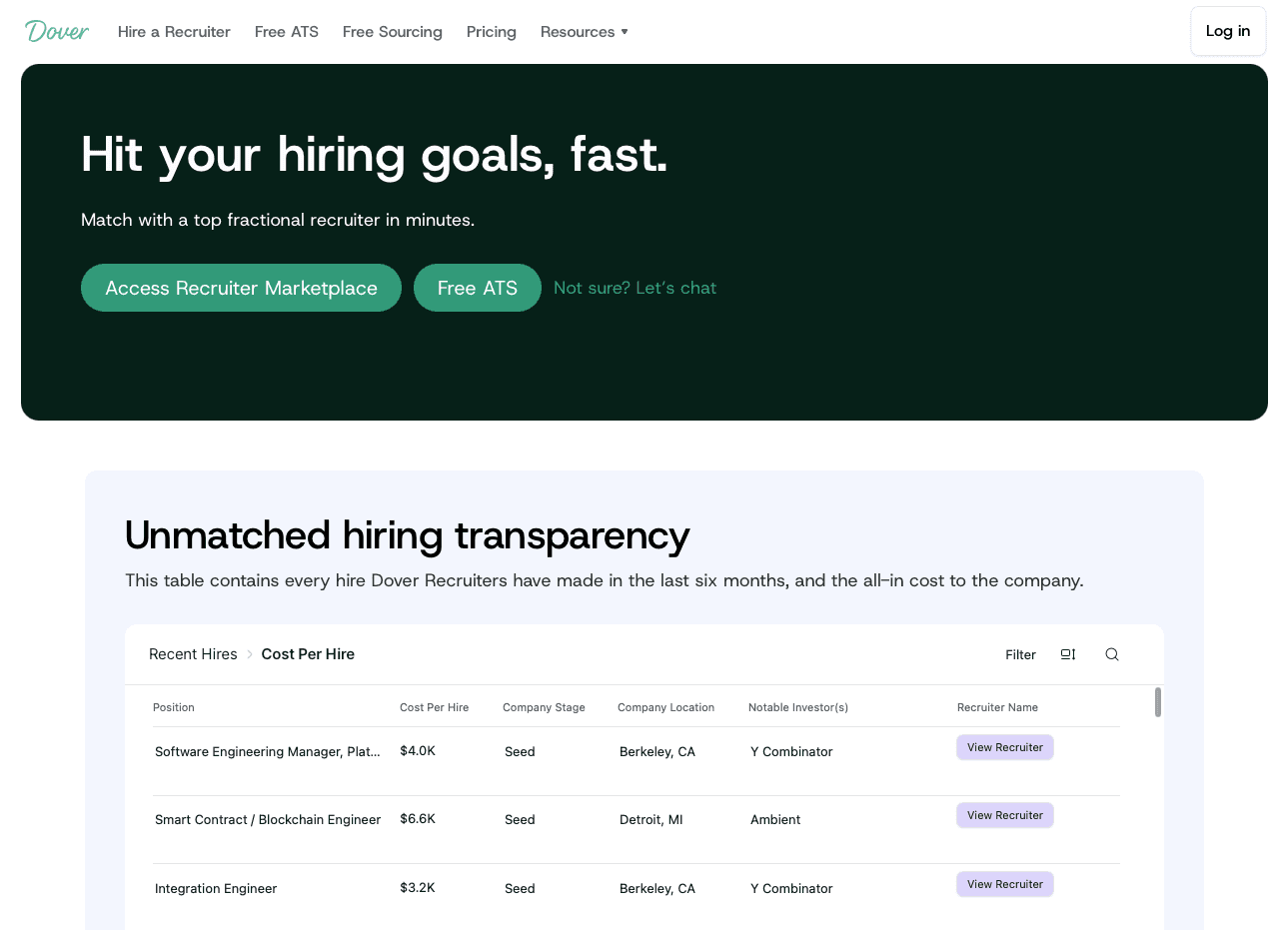

The recruitment sources outlined above only work when they’re connected, visible, and easy to manage in one place. Dover is built for that reality, giving startups a free ATS that pulls candidates from job boards, referrals, career pages, outbound sourcing, and agencies into a single system designed for fast-moving teams.

Dover’s ATS supports the full mix of recruitment sources by making distribution and tracking easy. Teams can post roles to 100+ job boards with one click, run employee referrals with built-in tracking, score applicants using AI, and build reusable talent pools from past candidates. A no-code career page collects direct applications, while sourcing tools help teams reach passive candidates without adding extra software.

When you need extra sourcing help, Dover's Recruiter Marketplace connects you with experienced fractional recruiters who can run outbound campaigns or handle campus recruiting. You pay hourly with no contracts, scaling support as hiring needs change.


The recruitment sources outlined above only work when they’re connected, visible, and easy to manage in one place. Dover is built for that reality, giving startups a free ATS that pulls candidates from job boards, referrals, career pages, outbound sourcing, and agencies into a single system designed for fast-moving teams.

Dover’s ATS supports the full mix of recruitment sources by making distribution and tracking easy. Teams can post roles to 100+ job boards with one click, run employee referrals with built-in tracking, score applicants using AI, and build reusable talent pools from past candidates. A no-code career page collects direct applications, while sourcing tools help teams reach passive candidates without adding extra software.

When you need extra sourcing help, Dover's Recruiter Marketplace connects you with experienced fractional recruiters who can run outbound campaigns or handle campus recruiting. You pay hourly with no contracts, scaling support as hiring needs change.


The recruitment sources outlined above only work when they’re connected, visible, and easy to manage in one place. Dover is built for that reality, giving startups a free ATS that pulls candidates from job boards, referrals, career pages, outbound sourcing, and agencies into a single system designed for fast-moving teams.

Dover’s ATS supports the full mix of recruitment sources by making distribution and tracking easy. Teams can post roles to 100+ job boards with one click, run employee referrals with built-in tracking, score applicants using AI, and build reusable talent pools from past candidates. A no-code career page collects direct applications, while sourcing tools help teams reach passive candidates without adding extra software.

When you need extra sourcing help, Dover's Recruiter Marketplace connects you with experienced fractional recruiters who can run outbound campaigns or handle campus recruiting. You pay hourly with no contracts, scaling support as hiring needs change.

Frequently Asked Questions

How do internal and external recruitment sources work together?

Internal sources like promotions and transfers work best for roles where company knowledge matters most, while external sources bring in new skills and perspectives your team doesn't have yet. Most companies use both: post internally first for speed and morale, then expand to external channels if the right fit isn't on your current team.

What's the real difference between traditional agencies and fractional recruiters?

Traditional agencies charge 20-30% of first-year salary (often $30,000+ per hire) and focus on placing candidates anywhere, while fractional recruiters work hourly on your specific roles and typically cost $2,000-$7,000 per hire. Fractional recruiters integrate with your team without long-term contracts, and you can scale their hours up or down based on your hiring needs.

When should I invest in building a talent pool database?

Start building a talent pool once you're hiring regularly (3+ roles per year) or when you notice yourself re-sourcing the same types of candidates repeatedly. An ATS with talent pool features lets you save past applicants and sourced candidates, often cutting sourcing time considerably on future roles since you're reaching back out to people who already know your company.

How do internal and external recruitment sources work together?

Internal sources like promotions and transfers work best for roles where company knowledge matters most, while external sources bring in new skills and perspectives your team doesn't have yet. Most companies use both: post internally first for speed and morale, then expand to external channels if the right fit isn't on your current team.

What's the real difference between traditional agencies and fractional recruiters?

Traditional agencies charge 20-30% of first-year salary (often $30,000+ per hire) and focus on placing candidates anywhere, while fractional recruiters work hourly on your specific roles and typically cost $2,000-$7,000 per hire. Fractional recruiters integrate with your team without long-term contracts, and you can scale their hours up or down based on your hiring needs.

When should I invest in building a talent pool database?

Start building a talent pool once you're hiring regularly (3+ roles per year) or when you notice yourself re-sourcing the same types of candidates repeatedly. An ATS with talent pool features lets you save past applicants and sourced candidates, often cutting sourcing time considerably on future roles since you're reaching back out to people who already know your company.

How do internal and external recruitment sources work together?

Internal sources like promotions and transfers work best for roles where company knowledge matters most, while external sources bring in new skills and perspectives your team doesn't have yet. Most companies use both: post internally first for speed and morale, then expand to external channels if the right fit isn't on your current team.

What's the real difference between traditional agencies and fractional recruiters?

Traditional agencies charge 20-30% of first-year salary (often $30,000+ per hire) and focus on placing candidates anywhere, while fractional recruiters work hourly on your specific roles and typically cost $2,000-$7,000 per hire. Fractional recruiters integrate with your team without long-term contracts, and you can scale their hours up or down based on your hiring needs.

When should I invest in building a talent pool database?

Start building a talent pool once you're hiring regularly (3+ roles per year) or when you notice yourself re-sourcing the same types of candidates repeatedly. An ATS with talent pool features lets you save past applicants and sourced candidates, often cutting sourcing time considerably on future roles since you're reaching back out to people who already know your company.

Final Thoughts on Selecting Your Recruitment Sources

Your hiring results depend on how well you combine the right sources of recruitment for each role and hiring window. Some positions need direct outreach on LinkedIn, others move fastest through referrals or targeted communities, and most benefit from several channels working together at once. Dover supports this approach by bringing job boards, referrals, career pages, and outbound sourcing into one place, while giving teams access to fractional recruiters when extra help is needed. Instead of committing to high agency fees or fixed processes, you can adjust your recruitment sources as hiring demand changes and only pay for support when it produces results.