

The debate around recruiting coordinator vs. recruiter often starts with confusion because both roles sit inside the same hiring team and work toward the same goal: filling open roles. From the outside, they look interchangeable. In reality, the day-to-day work, decision-making authority, and career path are very different. One keeps the hiring process moving through scheduling and candidate communication, while the other owns sourcing strategy, talent evaluation, and closing candidates. Understanding that distinction matters whether you’re planning your career or building a hiring team with the help of a trusted recruiting partner.
TLDR:
-
Recruiting coordinators manage scheduling and logistics while recruiters own sourcing and hiring decisions.
-
Coordinators earn an average of $56,072 vs. $62,099 for recruiters in 2026.
-
Many coordinators transition to recruiter roles within 1-2 years, depending on company structure and opportunity.
-
Recruiters carry revenue and growth impact because the quality of their hires directly affects company performance and team output.
-
Some modern recruiting solutions offer free ATS to handle coordinator tasks and connect you with fractional recruiters at $2,000-$7,000 per hire.
What Is a Recruiting Coordinator?
A recruiting coordinator handles the behind-the-scenes logistics that keep hiring moving smoothly. This role serves as the functional backbone of the recruitment team, managing schedules, coordinating interviews, and making sure candidates have a positive experience from application to offer.

The work is primarily administrative and process-centered. Recruiting coordinators schedule interview panels, send confirmation emails, track candidate communications, and maintain the applicant tracking system. They manage the day-to-day flow when you have multiple candidates in various interview stages.
This role rarely involves making hiring decisions or sourcing candidates. Instead, recruiting coordinators focus on execution and coordination, working closely with recruiters, hiring managers, and candidates. Many people start here before moving into recruiting roles.
What is a Recruiter?
A recruiter owns the full talent acquisition strategy and drives hiring outcomes. This role is about finding the right people, building relationships, and convincing top candidates to join your company.
Recruiters spend their time sourcing talent through LinkedIn, referrals, and industry networks. Some work as fractional recruiters on a part-time or project basis. They actively reach out to passive candidates who aren’t looking for jobs, craft compelling outreach messages, and build pipelines of qualified talent for current and future roles. When candidates apply or respond, recruiters screen resumes, conduct initial phone interviews, and assess whether someone is a strong cultural and skills fit.
The work is relationship-driven and strategic. Understanding what type of recruiter is best for your needs can help you make the right hiring decision. Recruiters partner with hiring managers to understand role requirements, advise on market conditions and salary expectations, and guide candidates through the interview process. They negotiate offers and help close deals when candidates have competing opportunities.
Recruiting Coordinator vs. Recruiter: Key Responsibilities
The easiest way to understand these roles is to look at what each person actually does during their workday.
| Recruiting Coordinator | Recruiter |
|---|---|
| Schedules interview panels and sends calendar invites | Sources candidates on LinkedIn and job boards |
| Updates candidate status in the ATS | Conducts phone screens and assesses fit |
| Sends follow-up emails and rejection letters | Builds talent pipelines for future roles |
| Coordinates travel and expenses for candidates | Advises hiring managers on market conditions |
| Maintains interview feedback forms | Negotiates offers and comp packages |
| Tracks hiring metrics and reports | Manages candidate relationships through close |
The split is clear: coordinators run the process while recruiters drive the outcome. Tasks involving talent decisions or strategic judgment fall to recruiters. Work that keeps candidates moving through stages belongs to coordinators.
Recruiting Coordinator vs Recruiter: Salary Comparison
Compensation reflects the different levels of responsibility between these roles. The average salary for a recruiting coordinator is $56,072 in 2026, while recruiters earn an average of $62,099 in 2026. That gap of roughly $6,000 makes sense given that recruiters handle strategic decisions and relationship management.
Location drives major salary variations for both roles. When deciding between hiring options, consider reading about fractional recruiters vs. full-time recruiters to determine which fits your needs. Recruiting coordinators in major metro areas like New York City and California often see meaningfully higher pay than national averages due to cost of living and market demand, while recruiters in tech hubs can command six-figure salaries when factoring in bonuses and commissions. Entry-level recruiting coordinators might start around $45,000, while senior coordinators with 3-5 years can reach $65,000 or more.
Skills Required for Each Role
Both roles need strong people skills and calendar management, but specific competencies differ considerably from there.
Recruiting coordinators succeed with exceptional organizational abilities to juggle multiple competing priorities. Managing 15 different interview schedules with multiple stakeholders means one calendar conflict can derail an entire hiring process. Attention to detail matters because a typo in an interview time or wrong Zoom link creates a poor candidate experience. ATS proficiency is required since you’re in the system all day updating statuses and pulling reports.
Recruiters need strategic thinking to build sourcing strategies and assess market talent. Sales skills help when convincing passive candidates to consider new opportunities. The best recruiters excel at relationship management, staying connected with candidates over months or years. Negotiation capabilities separate good recruiters from great ones during offer discussions.
Career Path: From Recruiting Coordinator to Recruiter
Many recruiting coordinators transition into recruiter roles within 1-2 years if opportunities are available and they take on sourcing or screening responsibilities. The progression path is straightforward because you’re already embedded in the hiring process.
The jump from coordinator to recruiter happens when you start taking on sourcing projects or conducting initial phone screens. Some companies create “associate recruiter” or “junior recruiter” roles as stepping stones. If you’re working at a startup, understanding what a startup recruiter does can help you manage your career path. You’ll know you’re ready when you understand the full candidate lifecycle and feel comfortable assessing talent.

From recruiter, the path splits based on your interests. Individual contributors typically move to senior recruiter (2-3 years), then principal or lead recruiter roles. The management track goes from recruiter to recruiting manager (3-4 years), then senior manager, and director or head of talent acquisition (7-10 years total).
Switching tracks is common. The skills you build as a coordinator (organization, process management, stakeholder communication) serve you throughout your career regardless of direction.
Talent Acquisition Coordinator: How It Differs
Talent acquisition coordinator and recruiting coordinator are often the same job with different titles. Many companies use the terms interchangeably to describe someone managing interview logistics and candidate coordination.
The distinction, when it exists, is subtle. Talent acquisition coordinators sometimes work at larger organizations where the TA function includes workforce planning and employer branding alongside hiring. In these settings, coordinators might support strategic initiatives like building talent pipelines for future headcount or coordinating campus recruiting programs.
Title choice usually reflects company culture more than actual job differences. Tech startups tend to use “recruiting coordinator” while enterprise companies often prefer “talent acquisition coordinator.”
Education and Experience Requirements
Most recruiting coordinator roles require a bachelor’s degree in any field (business, communications, psychology), though some startups accept associate’s degrees or strong administrative backgrounds. Entry-level positions often accept candidates with no recruiting experience, focusing on organizational skills, written communication, and calendar management. HR or operations internships help candidates stand out.
Recruiter positions often require 1-3 years of coordinator, HR, or related experience, showing familiarity with hiring processes before handling talent decisions. If you’re wondering when your company needs this role, read about the signs your startup needs to hire a recruiter. Some transition from sales roles given the relationship-building overlap. Senior recruiter roles generally require 3-5 years of full-cycle recruiting experience, with specialized positions (technical recruiting) demanding industry knowledge or proven success hiring for specific functions.
How Dover Supports Both Recruiting Coordinators and Recruiters
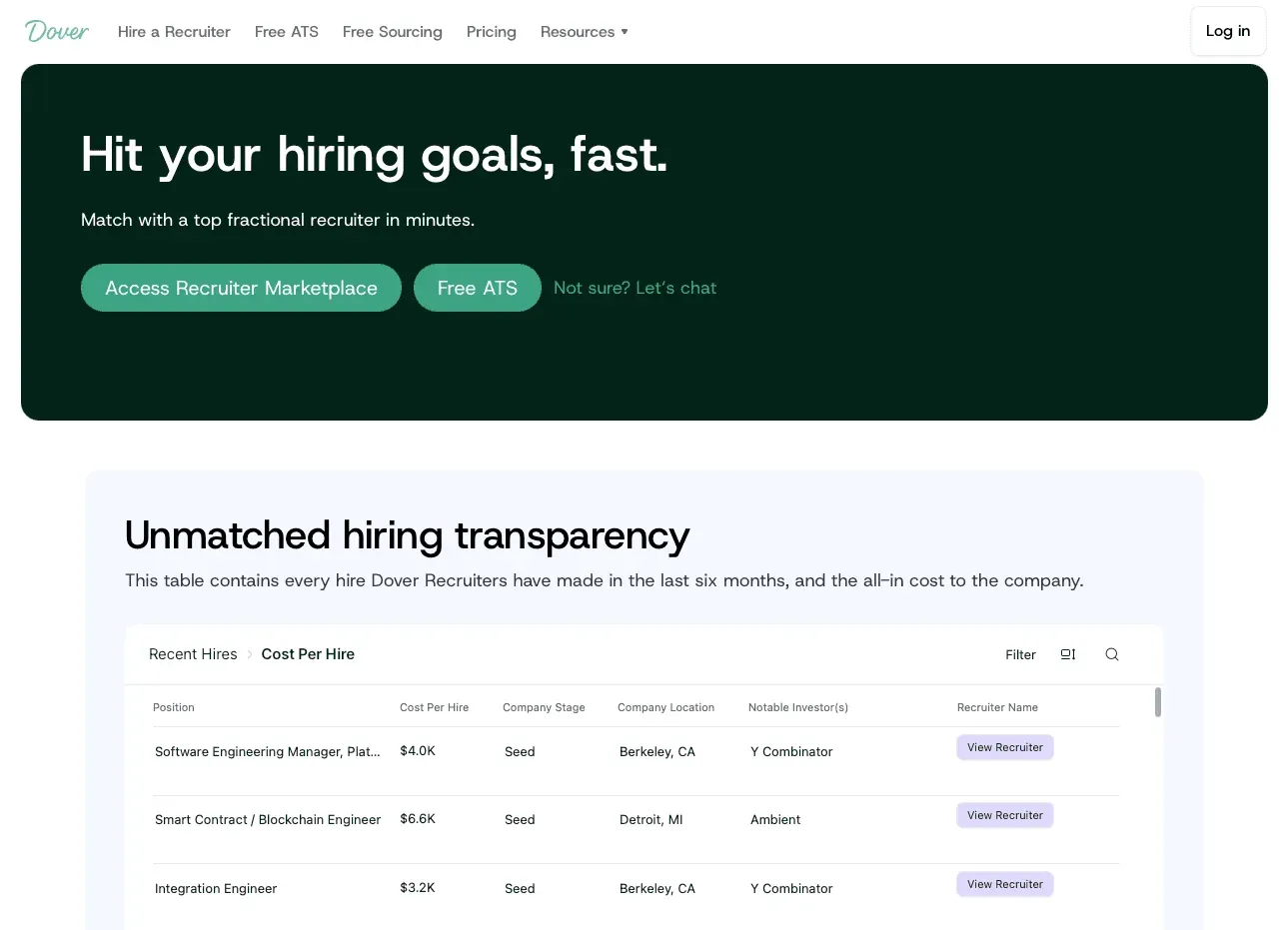
We built Dover to support hiring teams at different stages of growth, whether you need help with coordination or strategic recruiting.
Our free ATS gives recruiting coordinators the tools to manage scheduling, candidate tracking, and communications without manual spreadsheets. You can also access our Recruiter Marketplace to find experienced recruiting help. The system automates interview scheduling, sends templated emails, and keeps everyone updated on candidate progress.
When you need strategic recruiting help, our Recruiter Marketplace connects you with experienced fractional recruiters who handle sourcing, screening, and closing. Check out our guide on how to choose the right recruiter for your startup. You work with vetted professionals on an hourly basis with no long-term contracts, paying $2,000-$7,000 per hire instead of the $30,000+ that traditional agencies charge. Learn more about fractional recruiter costs and pricing models.
Frequently Asked Questions
How long does it take to move from recruiting coordinator to recruiter?
Many recruiting coordinators transition into recruiter roles within 1-2 years if they want to make the switch, depending on company structure and available opportunities. You’re ready when you understand the full candidate lifecycle and feel comfortable assessing talent, often after taking on sourcing projects or initial phone screens.
What’s the biggest difference between a recruiting coordinator and recruiter?
Coordinators run the hiring process (scheduling interviews, updating the ATS, sending emails) while recruiters drive hiring outcomes (sourcing candidates, conducting screens, negotiating offers). One manages logistics, the other makes talent decisions and builds relationships.
Can you become a recruiting coordinator with no experience?
Yes, many entry-level recruiting coordinator positions accept candidates with no recruiting experience. Companies focus on organizational skills, written communication, and calendar management over recruiting backgrounds, making this a common entry point into talent acquisition.
Final Thoughts on Recruiting Coordinator vs. Recruiter Decisions
The recruiting coordinator vs. recruiter decision usually becomes clear when founders feel the pain firsthand. If your biggest bottleneck is interview scheduling, candidate follow-ups, and keeping the process organized, coordination support comes first. If you have roles open but no steady pipeline of qualified candidates, you need sourcing and closing expertise. Many teams move through both stages as they grow, adding structure before adding strategy. Dover supports that progression by giving startups the tools to manage coordination and access experienced recruiting support when it’s time to scale hiring impact.