
If you’re trying to understand why crypto startups should hire a recruiter, it usually starts with a frustrating reality: the best blockchain engineers aren’t applying to your jobs. They’re already embedded in tight-knit communities, and by the time you reach them cold, they’re gone. That gap between open roles and actual access is where most teams fall behind. What tends to work better is a model built around speed, network depth, and flexible support, like newer approaches that connect hiring teams with recruiters who already know where to look.
TLDR:
-
Crypto roles sit open for weeks because the talent pool is small and moves fast.
-
Fractional recruiters cost $4,000-$7,000 per hire vs $18,000-$30,000 for agencies.
-
Web3 screening requires domain expertise most generalists lack.
-
DIY recruiting can cost founders $3,000-$5,000 weekly in lost productivity.
-
Some modern models offer fractional recruiters at $75-$125/hour with no contracts or placement fees.
The Crypto Talent Shortage Is Real and Growing
Crypto hiring is harder than most founders expect. The sector is growing fast, but the talent pool hasn’t kept pace, and that gap is hitting startups where it hurts. Around 60% of crypto employers report struggling to hire senior blockchain engineers, and the competition for the ones who do exist is fierce. Strong candidates rarely stay available for long; many are off the market within a few weeks of starting a search.

The problem runs deeper than competition alone. Roles like smart contract developers, protocol engineers, and tokenomics designers require a very specific blend of skills that took years to develop in meaningful numbers. In some specializations, there are as many as 17 open roles per qualified developer, which makes passive outreach the only realistic path. Posting a job and waiting simply won’t work. By the time most founders realize their pipeline is dry, their best candidates have already signed somewhere else.
Speed Matters More Than Ever in Crypto Hiring
Crypto moves fast. Market conditions shift within weeks, token launches get pulled forward, and a competitor’s funding round can reshape your hiring priorities overnight. Crypto job postings grew 47% in 2025, widening the gap between open roles and available talent. In that environment, a slow hiring process is a real liability.
The two-week window for top candidates is a forcing function. If your process involves three rounds of back-and-forth emails to schedule calls, a week to consolidate feedback, and another week to get an offer approved, you’ve already lost. The best engineers and protocol designers aren’t sitting idle, and they’re usually entertaining multiple conversations at once.
Speed affects more than just candidate outcomes. Every week a key role sits open, your existing team carries more load, product timelines slip, and momentum stalls. For a crypto startup operating in a fast-moving market, those compounding delays can cost you far more than one missed hire.
Recruiters who specialize in crypto understand this tempo. They move faster because they’ve built the pipelines, know who’s open to new opportunities, and can get a warm candidate on a call within days instead of weeks. That head start matters when your competitors are making offers on the same shortlist.
Technical Screening in Web3 Requires Domain Expertise
Hiring a blockchain engineer looks straightforward until you’re actually reviewing resumes. Without deep crypto knowledge, it’s nearly impossible to tell the difference between a strong Solidity developer and someone who copied a tutorial. Smart contract audits, consensus mechanism design, zero-knowledge proofs: these aren’t skills you can assess with a generic coding test.
Generalist recruiters run into this wall constantly. They can screen for years of experience or a recognizable employer, but they can’t probe whether a candidate actually understands reentrancy vulnerabilities or has worked with Rust at the protocol layer. That gap lets underqualified candidates slip through, and it means strong candidates sometimes get filtered out for the wrong reasons.
There are a few areas where this expertise gap tends to matter most:
-
Knowing which credentials actually signal depth in Web3 vs. which ones are superficial, like certifications that don’t reflect real protocol-level work.
-
Reading a candidate’s open-source contributions and GitHub history with enough context to understand what the work actually involved.
-
Recognizing which projects on a resume carry genuine weight in the Web3 community and which are overstated.
Crypto-specialized recruiters have done enough of these searches to ask the right questions and avoid the costly misjudgments that generalists often make.
The Hidden Cost of DIY Recruiting for Crypto Founders
Recruiting yourself feels free until you add up what it actually costs. Founders typically spend 15-25 hours per week on DIY recruiting tasks. At a $200+ per hour opportunity cost, that’s roughly $3,000-$5,000 in lost productivity every week, time that could otherwise go toward product, fundraising, or closing customers.
For a crypto founder, the stakes are higher. The window to ship, raise, or capture market share is narrow. Time spent chasing sourcing lists, scheduling screening calls, and writing job descriptions is time pulled directly from the work that moves the company forward.
Multiply that across several open roles and the math gets uncomfortable fast. What looked like a cost-saving decision starts looking like one of the more expensive choices you made that quarter.
Why Traditional Agencies Fall Short for Crypto Startups
Traditional agencies have a structural problem that has nothing to do with effort: their incentives don’t align with yours. An agency gets paid when a candidate accepts an offer. Whether that candidate stays six months or becomes a core part of your team is largely irrelevant to their fee.
Contingency fees typically run 15-25% of first-year salary. For a $120,000 engineering hire, that’s $18,000 to $30,000 out the door, with no meaningful accountability for fit or retention.
The spray-and-pray approach compounds this. Agencies often blast the same candidate profiles across multiple clients to maximize placement odds. In a small, relationship-driven space like Web3, that damages your employer brand fast. Candidates notice when they’re being shopped around.
Then there’s the knowledge gap. Most traditional agency recruiters don’t know Solidity from Rust, and can’t meaningfully assess whether a candidate has real protocol experience. You end up paying a premium for screening that any generalist could have done.
| Recruiting Model | Cost Per Hire | Speed to Hire | Web3 Technical Expertise | Flexibility | Incentive Alignment |
|---|---|---|---|---|---|
| DIY (Founder-Led) | No direct fee, but $3,000-$5,000/week in lost founder productivity | Slow; founders lack pre-built pipelines and candidate relationships | Varies; many founders lack the expertise to accurately screen Solidity or protocol-level skills | Fully flexible but unsustainable at scale | High, but competes directly with product and fundraising priorities |
| Traditional Agency | 15-25% of first-year salary ($18,000-$30,000 for a $120,000 hire) | Moderate; large databases but no warm Web3 community ties | Low; many agency recruiters lack the expertise to distinguish Rust from Solidity | Low; fixed contracts and placement fee structures | Poor; paid on placement, not on retention or fit |
| Fractional Recruiter (Dover) | $4,000-$7,000 per hire billed at $75-$125/hour | Fast; recruiters have warm relationships inside Web3 communities | High; specialized recruiters assess protocol experience and open-source contributions accurately | High; scale up or down with no contracts or placement fees | Strong; paid for time and expertise, focused on finding the right fit |
Fractional Recruiters Offer the Best of Both Worlds
Fractional recruiting sits between the two extremes most crypto founders are stuck choosing between: burning their own time or overpaying an agency. A fractional recruiter works as a dedicated extension of your team, hired by the hour instead of by the placement.
The cost difference is real. Where traditional agencies charge fees that can reach $18,000-$30,000 for a single hire, fractional engagements typically cost $4,000-$7,000 per role. You’re paying for time and expertise, not a transaction fee. That model aligns incentives far better; your recruiter is focused on finding the right fit, not closing the fastest deal.
Flexibility is the other advantage. Hiring waves in crypto rarely follow a predictable schedule. A fractional model lets you ramp up recruiting support ahead of a product launch and scale back between cycles, with no contracts or lock-in.
Access to Specialized Crypto Talent Networks
Many of the best crypto developers aren’t actively applying on job boards. They’re deep in Discord servers, contributing to open-source protocols, and showing up at niche conferences most founders have never heard of. Reaching them takes relationships built over years, not a LinkedIn message.
Specialized recruiters already have those relationships. They know who’s quietly open to something new, which GitHub contributors are worth a conversation, and which Ethereum Foundation alumni are between projects. That kind of warm access can cut weeks off a search.
Why Warm Networks Matter in Crypto Hiring
Passive candidates in Web3 are often less responsive to traditional cold outreach channels, which means a recruiter with genuine community ties can reach people who would otherwise never see your role. This is especially useful for roles like protocol engineers, tokenomics designers, and smart contract auditors, where the talent pool is genuinely small and highly sought after.
How Dover’s Recruiter Marketplace Works for Crypto Startups
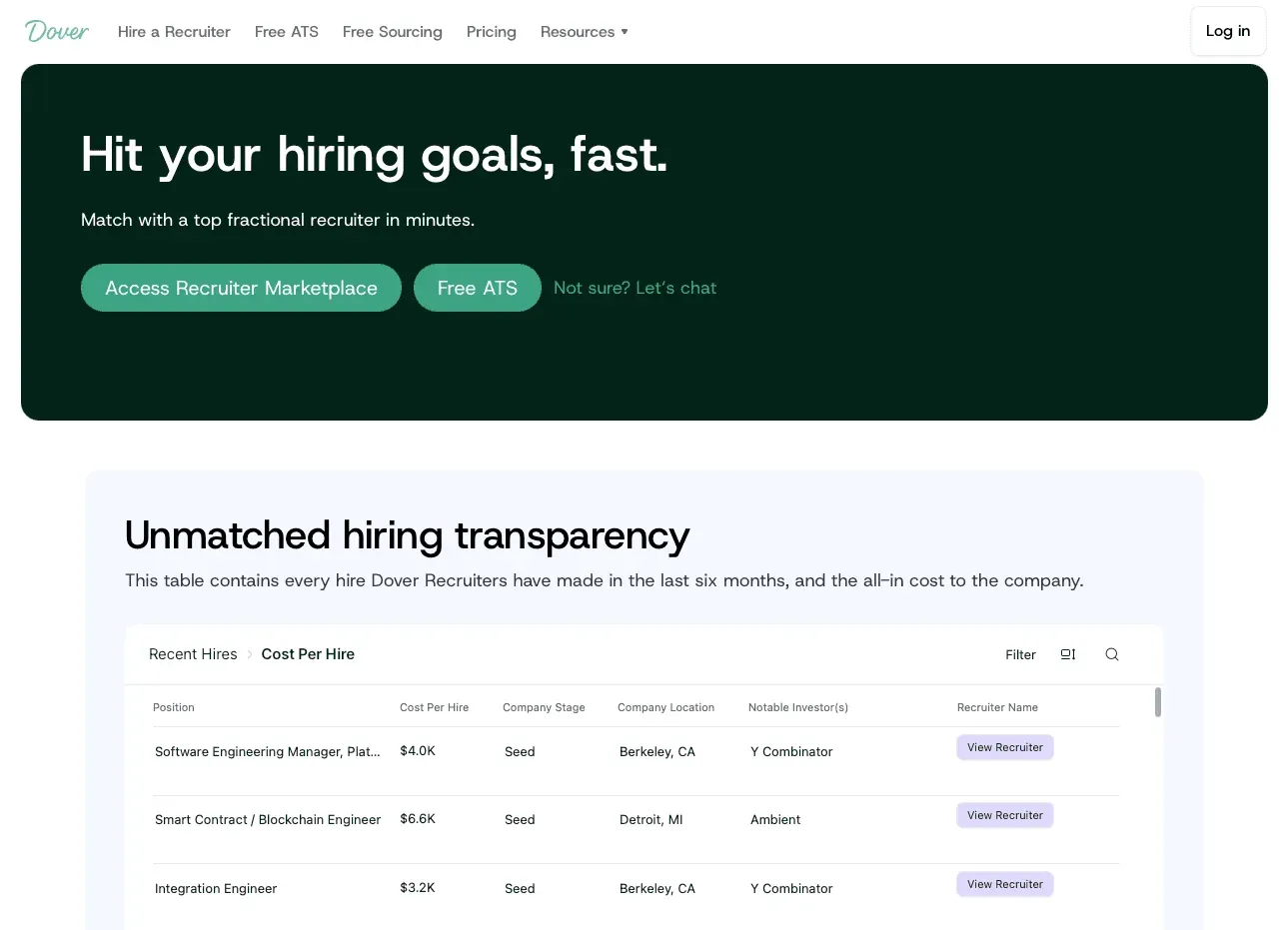
Dover pairs fractional recruiters with a free ATS so your recruiting process lives in one place. The recruiter works as a dedicated extension of your team, not a vendor shopping your roles across multiple clients. Both sides operate from the same system, so you always have visibility into sourcing activity, candidate flow, and where things stand.
Dover’s recruiter marketplace runs on a highly selective vetting process, drawing from experienced recruiters with deep startup hiring backgrounds. Hourly rates typically run between $75 and $125, and most roles filled in 20-30 recruiter hours, which puts the cost per hire well below what a traditional agency would charge. There are no contracts and no placement fees. You can scale up ahead of a token launch and pull back between hiring cycles without penalty.
For crypto startups that need to move fast without locking into expensive commitments, that kind of flexibility is genuinely hard to find elsewhere in the recruiting market.
Frequently Asked Questions
Can you hire crypto engineers without deep blockchain knowledge yourself?
Yes, but you’ll likely struggle to screen candidates accurately. Specialized recruiters who understand smart contract audits, consensus mechanisms, and protocol-level work can ask the right technical questions and assess candidates properly, where generalists often miss important red flags or filter out strong candidates for the wrong reasons.
What’s the fastest way to fill a blockchain engineering role in 2026?
Work with a recruiter who has warm relationships in the Web3 community and can reach passive candidates within days. Top crypto engineers are typically off the market within two weeks, so speed depends on accessing candidates who aren’t actively job hunting and moving them through your process before competitors do.
How much does fractional recruiting cost compared to traditional agencies?
Fractional recruiters typically cost $4,000 to $7,000 per hire billed hourly, while traditional agencies charge 15-25% of first-year salary ($18,000 to $30,000 for a $120,000 hire). The hourly model means you pay for time and expertise instead of a placement fee, with better aligned incentives around finding the right fit.
Should crypto startups hire a full-time recruiter or use fractional support?
Fractional recruiting works best for companies hiring 5-50 roles per year with variable hiring needs. Consider bringing on your first full-time recruiter around 15-20 annual hires, when the $85,000-$170,000 loaded cost of a full-time hire makes more sense than scaling fractional support.
Final Thoughts on Hiring for Web3 Startups
Understanding why crypto startups should hire a recruiter often comes down to speed, access, and focus. Dover gives teams a way to move quickly by combining experienced recruiters with a system that keeps everything visible and organized, without locking you into long-term costs. That balance makes it easier to stay competitive in a market where timing matters and strong candidates don’t stay available for long.