
Most early-stage teams treat hiring as a series of disconnected tasks until a bad hire or a drawn-out search makes the cost of that approach clear. Full Cycle Recruiting is the alternative: a structured, end-to-end process owned by one person or team, covering every stage from role definition to the new hire’s first day. This guide walks through each of the six stages.
TLDR:
-
Full cycle recruiting is an end-to-end hiring process that covers every stage from defining the role to onboarding, owned by one person or team instead of handed off between departments.
-
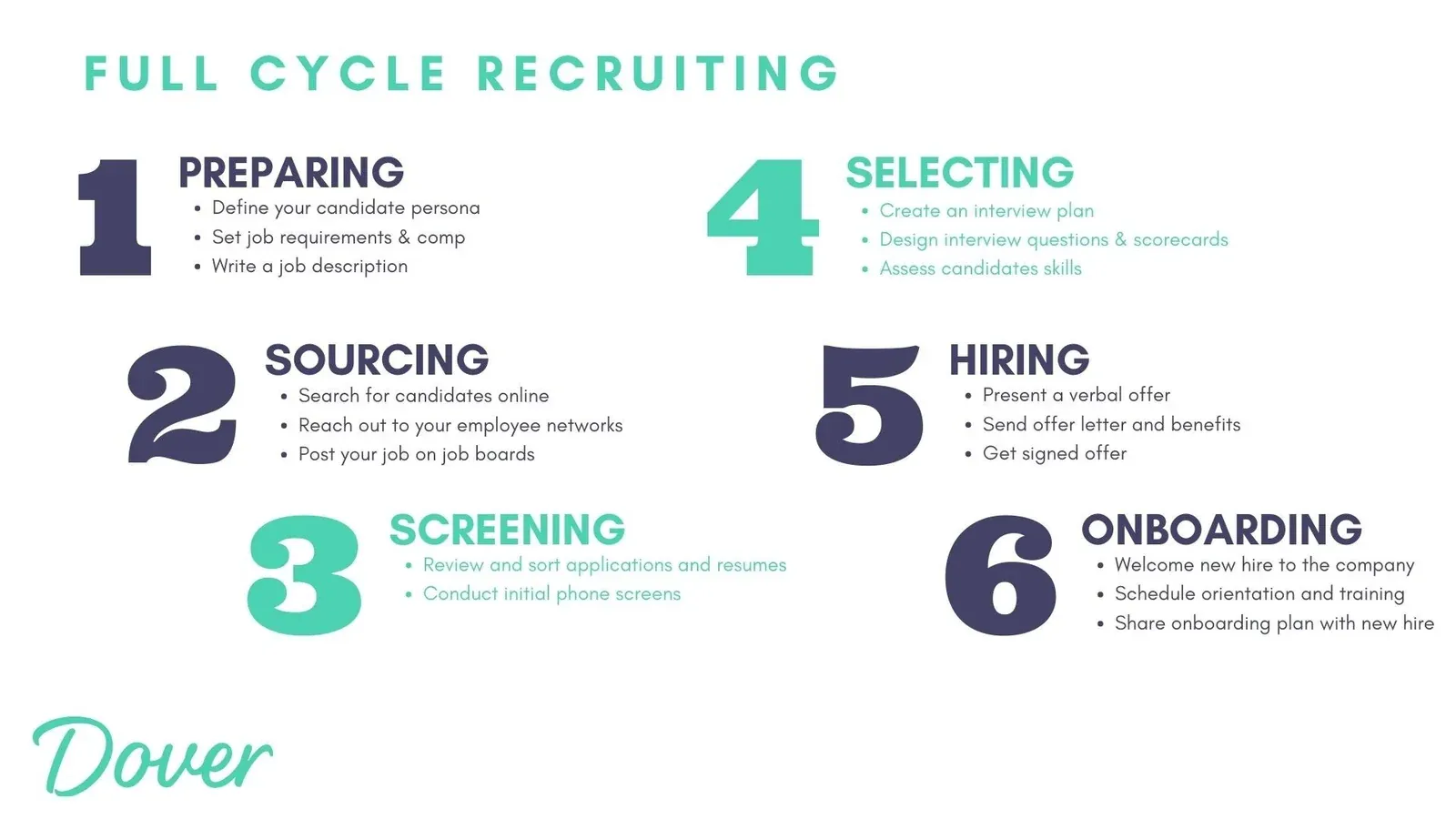
The process has six steps: preparation, candidate search, screening, evaluation, hiring and onboarding.
-
A structured full cycle recruiting approach lowers hiring costs, reduces time-to-hire and helps minimize unconscious bias across your team.
-
Standardized interview questions, scorecards and structured debriefs improve decision quality and keep evaluations consistent for every candidate.
-
An all-in-one recruiting platform can handle candidate search, applicant tracking, interview planning and offer management in one place, making it easier to build a repeatable hiring process at scale.
6 Stages of the Full Cycle Recruiting Process
Preparing
Preparing is the first step in the full cycle recruitment process where you want to determine what you’re looking for in your new employee. Once you’ve defined who you’re looking for and what skills they need to have, you can use that information to create a job description.
Step 1: Define your candidate persona
Gaining a full understanding of your ideal candidate’s goals, experiences, and qualifications will help you identify potential candidates throughout the process.
Step 2: Decide your job’s requirements and compensation range
Job Requirements
It’s important to align internally on what the requirements for the job will be. You’ll want to identify both the hard skills that are requirements (must haves) and the preferences (nice-to-haves) for the new role.
Compensation Range
Structuring your company or team’s compensation, especially in the early stages, requires thoughtfulness and foresight. There are a few things you can do to help create a framework for compensation that helps you attract talent, compensate your employees equitably, and bolster employee retention.
Step 3: Write a great job description
A great job description should be action-focused and easy to skim. An Indeed survey of more than 2,000 job seekers found that 52% say the quality of a job description is “very” or “extremely” influential on their decision to apply. Job seekers most commonly report spending three to five minutes reading a job description before deciding whether to apply.
-
Include examples of how past experience transfers to the role and call out what makes your organization distinct, such as its culture, strengths and perks.
-
Define expected outcomes instead of listing general responsibilities. Describing what success looks like over the first 30 to 90 days gives candidates a clearer picture of the role.
-
Assess whether requirements are truly must-haves or nice-to-haves. A long undifferentiated list causes qualified candidates, particularly women and underrepresented groups, to self-select out before applying.
Sourcing
Sourcing is the second step in the full cycle recruitment process where you want to find qualified candidates for your role. This typically involves posting your job on job boards, reaching out to people in your employees’ networks, and sending cold outreach to candidates who have the skills you’re looking for in the role.
At Dover, we have tools to help with sourcing.
-
Sourcing Autopilot finds and emails prospective candidates for you, making outbound recruiting completely hands-free. You simply define the criteria you’re looking for in a candidate and Sourcing Autopilot can automatically email personalized outreach to qualified candidates.
-
Sourcing Copilot is an AI-powered Chrome extension that allows you to source and email candidates directly from LinkedIn.
Screening
Screening is the third step in the full cycle recruitment process where you go through applications and conduct initial screening calls so that your team is only meeting with candidates who are a good fit for the position.
Step 1: Resume Screening
Resume screening is perhaps the most time consuming part of the process, but is a necessary step in determining which candidates will make it to the interviews. You will want to parse through each resume carefully to choose only those people who would be a good fit for the job.
Step 2: Phone Screening
Phone screens allow you to:
-
Check for potential dealbreakers early on (e.g. availability, relocation, proficiency in your tech stack, etc.)
-
Ask for clarification on information in candidates’ resumes or LinkedIn profiles
-
Assess candidates’ verbal communication skills (in some cases, test candidates for their ability to speak foreign languages)
-
Get to know candidates
-
For passive candidates, learn about their goals and desire to switch companies
For initial screens, you’ll want to create a standardized list of questions that you ask each candidate in the same order. Why? Studies show that asking questions in the same order for all candidates results in higher predictive validity on job performance and lower individual interviewer bias.
Standard logistical questions that Dover Interviewers use during phone screens.
Selecting
Selecting candidates is the fourth step in the process where your team conducts interviews and determines who will move forward in the process. It’s a tricky step because this is a team effort. Everyone on your hiring team plays a part in assessing candidates and alignment here can make or break the hiring process.
Step 1: Define what selection criteria you’re looking for
The core team (hiring manager, recruiter and leadership) should align on candidate qualities before interviews begin.
Step 2: Design an interview plan
It’s important to set up your interview process including how many stages of interviews you want candidates to go through. Your interview process should include enough stages to find the best candidate for your company while providing a positive candidate experience throughout the interview process. You can build your interview plan in your applicant tracking system.
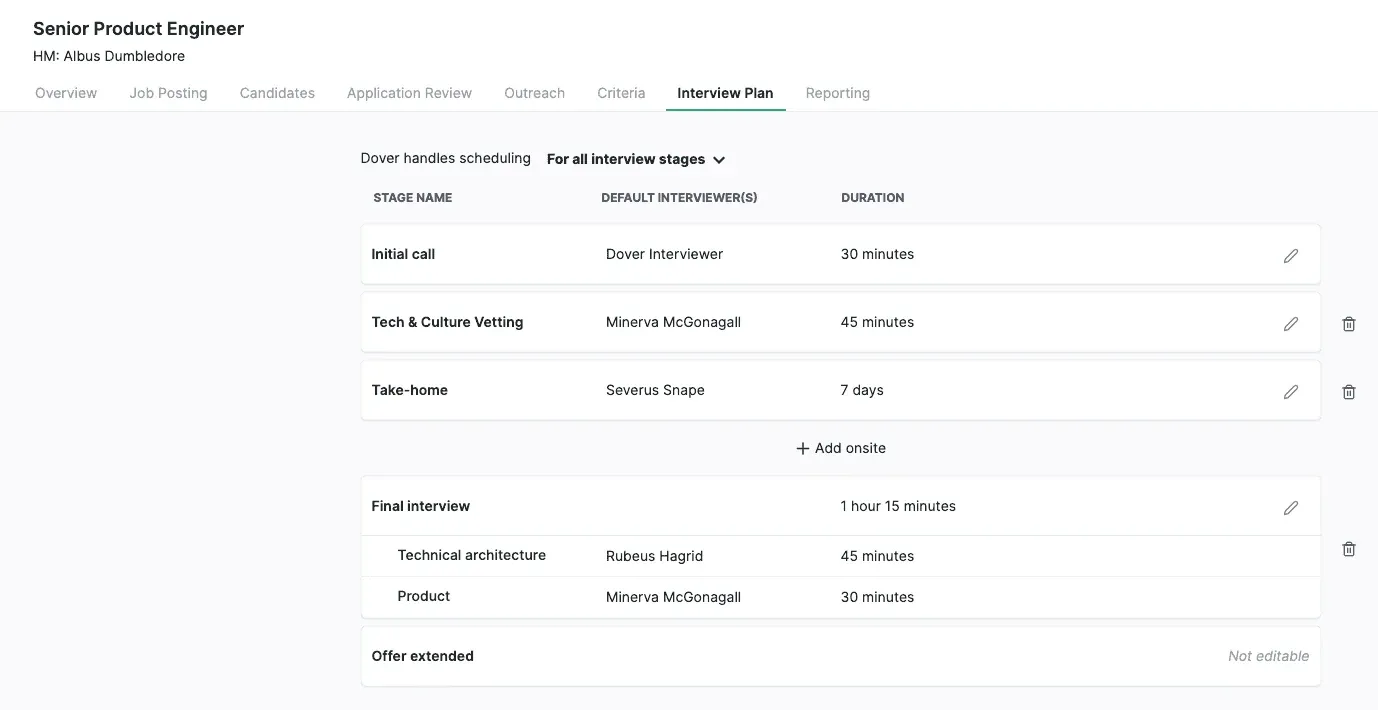
Dover ATS Interview Plan
Step 3: Create interview questions and scorecards
Based on the qualities you’re looking for, the next step is to create an interview rubric and keep it somewhere where it can be easily accessed.
If you’ve never hired for a role or hired in general before, the best way to develop a rubric is to ask folks at other companies what they’ve found to be critical in assessing different personas and helping them make a great hire. You can check out Dover’s interview process best practices or our guides to hiring account executives and sales representatives, CSMs, designers, engineers, marketers, and product managers.
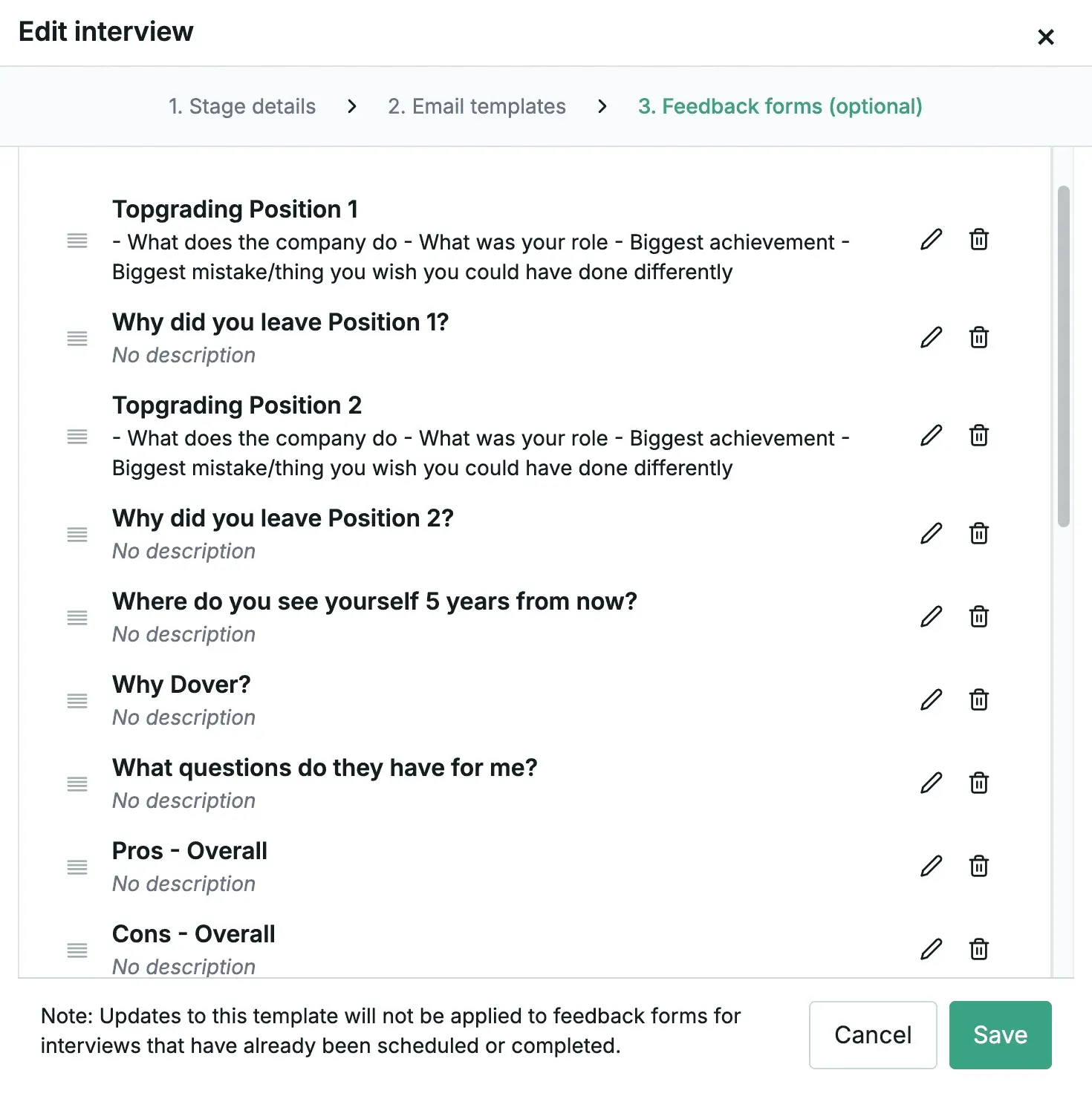
Dover’s ATS lets you add feedback forms / scorecards for each interview stage.
Step 4: Make scorecards accessible to all interviewers
Once you have a rubric, make it accessible to everyone involved in hiring. A centralized ATS lets interviewers submit structured feedback so every candidate gets graded against the same criteria.
You don’t have to buy an expensive ATS to do this. You can easily set up a table in a tool like Notion, Google Sheets or Airtable.
Step 5: Interview candidates and conduct a debrief
After the final interview with each candidate, conducting a debrief with all of the interviewers is a great way to align on the candidate to determine whether or not you should make them an offer.
Hiring
Hiring is the fifth step where you’ve narrowed the field and are ready to extend an offer. Negotiation is common here, so know your terms before the conversation starts.
Always present a verbal offer before sending a written one. This gives the candidate a chance to ask questions and gives you a chance to read their reaction before anything is signed.
Take a transparent approach to closing. If you’re not willing to share your biggest challenges or are evasive about revenue, you’ll lose credibility with the strongest candidates.
After presenting the offer, ask: “We’re all SUPER excited to work with you. Is there anything else we can do to get you onboard?” Sometimes you can close them on the spot.
-
Sample offer letter template
Onboarding
Onboarding is the final stage of the full cycle recruitment process and is unique to an end-to-end recruiting. Onboarding your new employee includes welcoming them to the company, introducing them to the team, and scheduling them for training and orientation.
With many companies adopting remote-first work policies, Dover created this guide to remote onboarding at startups with a few simple steps to create a remote-friendly onboarding experience.
5 Benefits of Full Cycle Recruiting
There are five key benefits to a managed, end to end recruiting process that has been thoughtfully structured and tracked over time:
| Area | Without Full Cycle Recruiting | With Full Cycle Recruiting |
|---|---|---|
| Cost | Hiring the wrong person leads to re-hiring costs that far exceed the original budget | A structured process lowers cost per hire by reducing the risk of bad hires |
| Visibility | No consistent tracking means blind spots across your candidate pipeline | Clear metrics on engagement, response rates, and hiring times make gaps easy to spot |
| Speed | Candidates stall or drop off without timely communication | Automation and timely follow-ups keep candidates moving through the process |
| Team Alignment | Siloed feedback and misaligned interviewers slow down decisions | Shared scorecards and clear roles improve how teams communicate and decide |
| Bias Reduction | Inconsistent evaluation opens the door to unconscious bias | Structured interviews and standardized questions reduce bias across the team |
How Dover Supports Full Cycle Recruiting
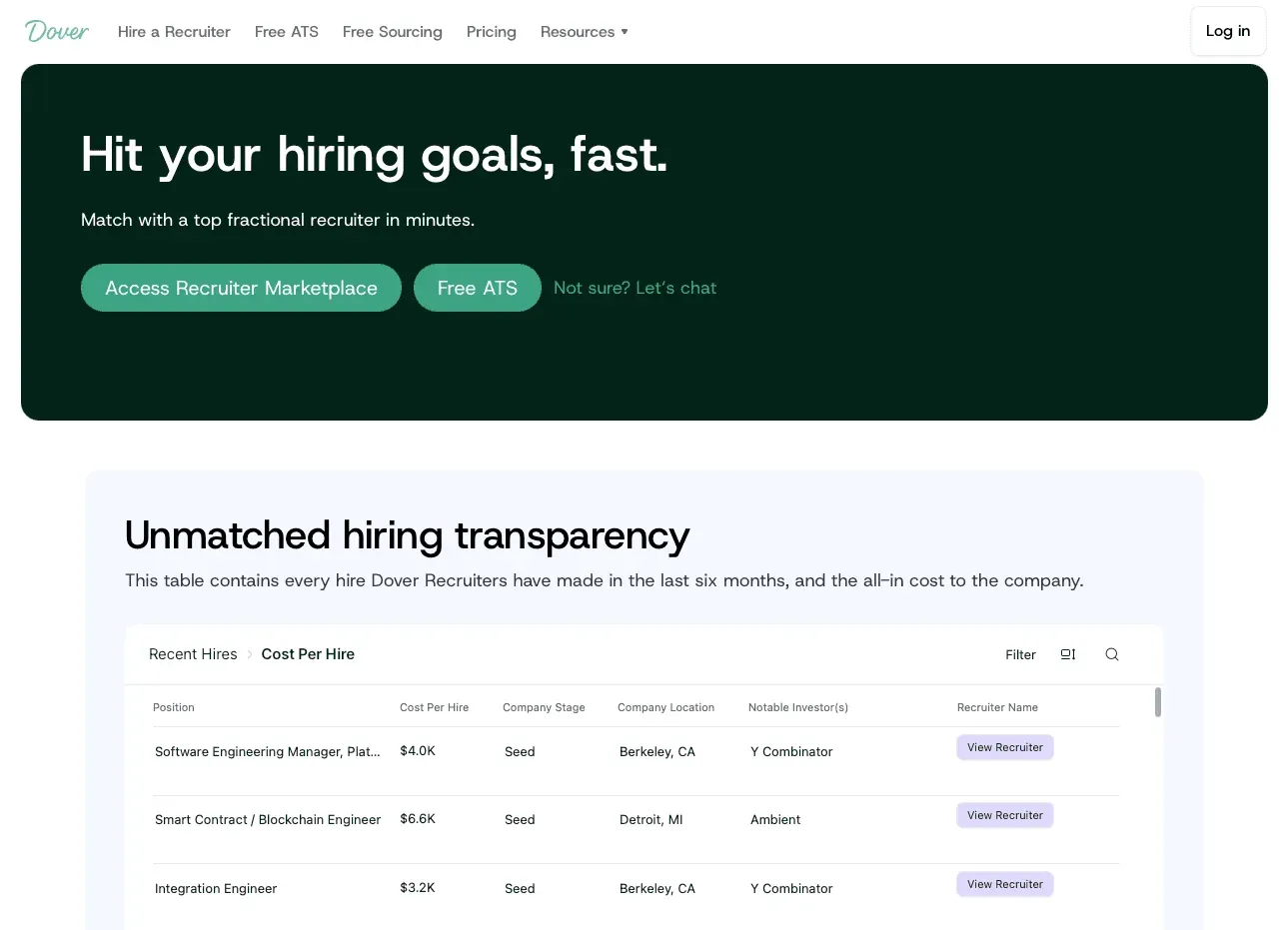
Dover’s free ATS has full cycle recruiting best practices built in across all six steps. Select from 200+ role types to auto-generate a job description, phone screen questions and interview plan. It handles job posting to 100+ boards, resume screening, scheduling and pipeline tracking in one place.
For roles needing hands-on support, Dover connects you with fractional recruiters who can own the full process or cover specific stages like candidate sourcing and closing. Pricing runs $2,000 to $7,000 per hire at $75 to $125 per hour, no long-term contracts, with an $800 refundable deposit. Each recruiter carries verified reviews and works directly from your ATS pipeline.
Dover also serves as the infrastructure layer fractional recruiting agencies build on. Agencies run pipelines and track metrics across client accounts from one shared dashboard, with all data staying in the client’s ATS after the engagement ends. Dover supports both the agency path and in-house hiring without requiring a switch as needs change.
FAQs
What’s the difference between full cycle recruiting and a standard hiring process?
Full cycle recruiting treats every stage from role definition to onboarding as a single connected process owned by one person or team, so candidates move faster, evaluators work from the same rubrics, and nothing falls through the gap between a recruiter finishing a search and a hiring manager picking it up cold.
How do you reduce unconscious bias in a full cycle recruiting process?
Use standardized questions asked in the same order for every candidate, shared scorecards, and structured debriefs, research on structured interviewing shows this improves performance prediction and reduces affinity bias.
How do I write a job description that improves applicant quality?
Lead with expected outcomes over the first 30 to 90 days instead of a generic responsibilities list, and separate hard requirements from nice-to-haves, a long undifferentiated list causes qualified candidates to self-select out before applying. Separating requirements from preferences matters for applicant pool diversity: a long undifferentiated requirements list causes qualified candidates, particularly women and underrepresented groups, to self-select out before applying.
Final Thoughts on Full Cycle Recruiting
Full Cycle Recruiting treats hiring as a complete, connected process instead of a series of handoffs. The structure is what makes the difference, and Dover’s free ATS has full cycle best practices built in across all six steps, with hands-on Embedded Recruiter support available for teams that need it.
What is full cycle recruiting?
An organization’s success starts with its people. But finding, hiring, and onboarding the best talent is challenging. That’s where full cycle recruiting comes in.
Full cycle recruiting (also known as full life cycle recruitment) is the process of finding new employees from recruiting to hiring. It begins with the need to fill a job position, then searches for candidates, then selects candidates through an interview process, and finally choosing and onboarding your new hire. The full cycle recruitment process consists of 6 stages: preparing, sourcing, screening, selecting, hiring, and onboarding.
How Dover can help you implement full cycle recruiting
Dover’s free ATS has full cycle recruiting best practices built in across all six steps. Select from 200+ role types to auto-generate a job description, phone screen questions and interview plan. It handles job posting to 100+ boards, resume screening, scheduling and pipeline tracking in one place.
For roles needing hands-on support, Dover connects you with fractional recruiters who can own the full process or cover specific stages like candidate sourcing and closing. Pricing runs $2,000 to $7,000 per hire at $75 to $125 per hour, no long-term contracts, with an $800 refundable deposit. Each recruiter carries verified reviews and works directly from your ATS pipeline.
Dover also serves as the infrastructure layer fractional recruiting agencies build on. Agencies run pipelines and track metrics across client accounts from one shared dashboard, with all data staying in the client’s ATS after the engagement ends. Dover supports both the agency path and in-house hiring without requiring a switch as needs change.
Frequently Asked Questions
What’s the difference between full cycle recruiting and a standard hiring process?
Full cycle recruiting treats every stage from role definition to onboarding as a single connected process owned by one person or team, so candidates move faster, evaluators work from the same rubrics, and nothing falls through the gap between a recruiter finishing a search and a hiring manager picking it up cold.
How do you reduce unconscious bias in a full cycle recruiting process?
Use standardized questions asked in the same order for every candidate, shared scorecards, and structured debriefs, research on structured interviewing shows this improves performance prediction and reduces affinity bias.
How do I write a job description that improves applicant quality?
Lead with expected outcomes over the first 30 to 90 days instead of a generic responsibilities list, and separate hard requirements from nice-to-haves, a long undifferentiated list causes qualified candidates to self-select out before applying. Separating requirements from preferences matters for applicant pool diversity: a long undifferentiated requirements list causes qualified candidates, particularly women and underrepresented groups, to self-select out before applying.